
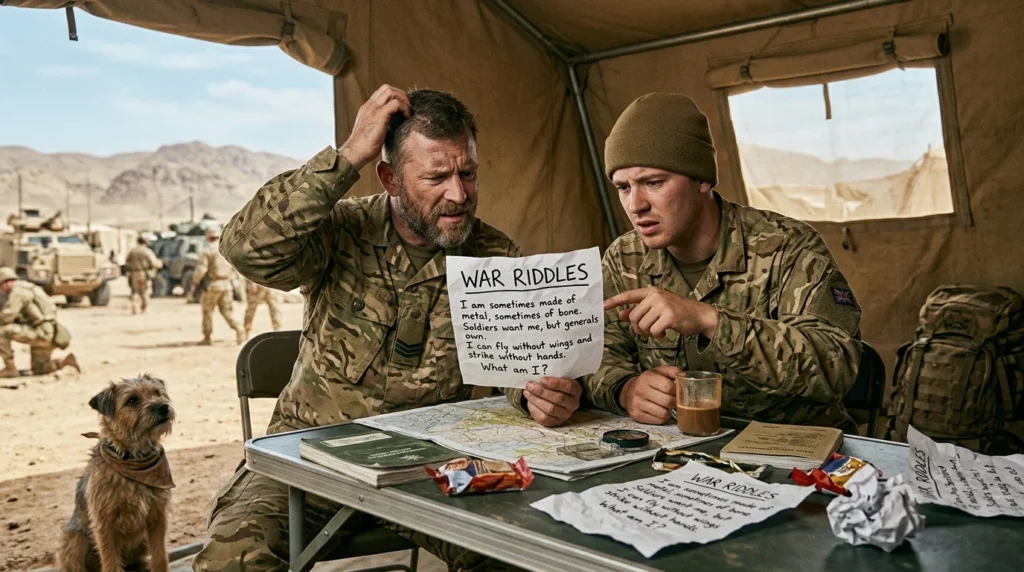
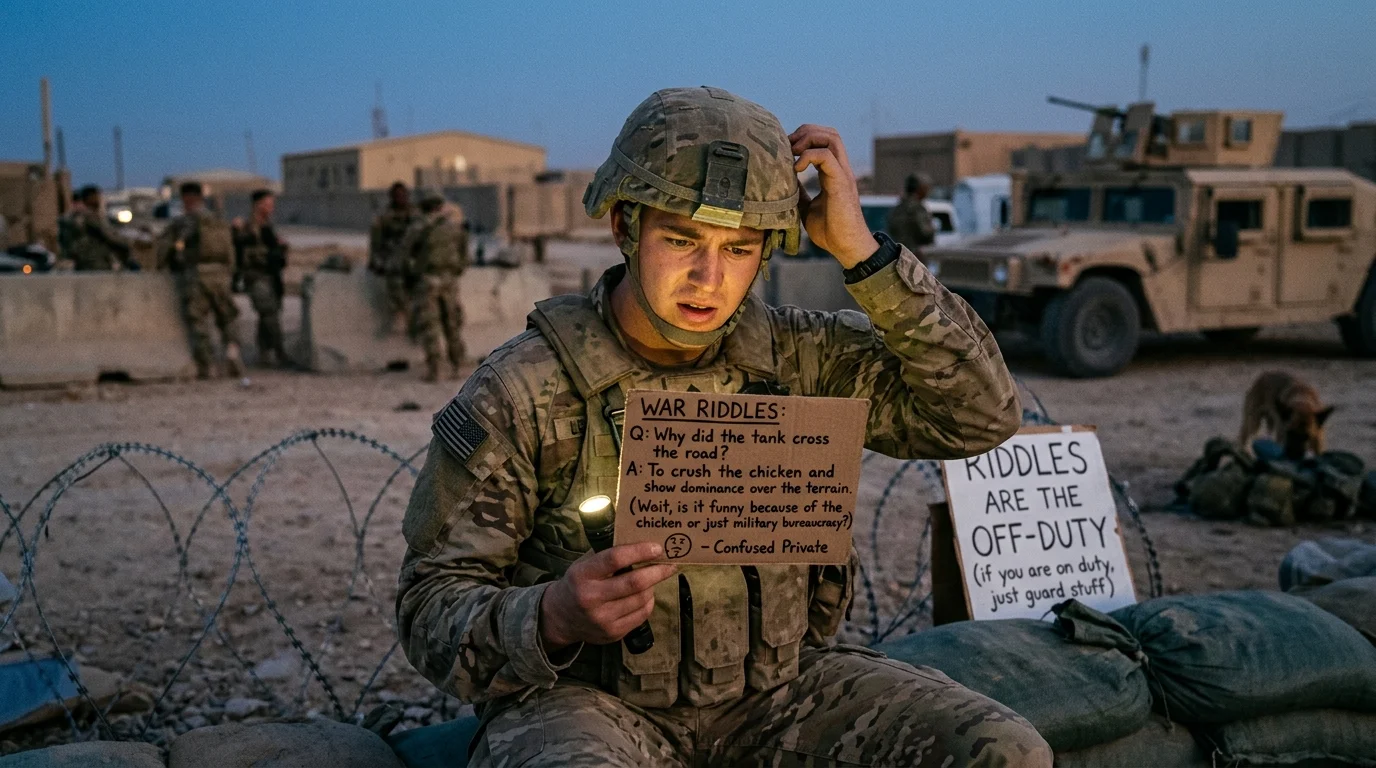
🪖 Easy War Riddles for Kids
These simple history-themed riddles introduce children to words and ideas commonly encountered when learning about wars and peace.
- I show where countries, borders, rivers, and armies may be located. What am I? 👉 A map
- I am worn on a soldier’s head to provide protection. What am I? 👉 A helmet
- I am a person who serves in an army. Who am I? 👉 A soldier
- I can be carried on a pole and represent a country or group. What am I? 👉 A flag
- I can be awarded to someone for bravery or service. What am I? 👉 A medal
- I am a written message sent from one person to another. What am I? 👉 A letter
- I am an agreement intended to stop fighting between opposing sides. What am I? 👉 A peace treaty
- I can mark the place where an important historical event happened. What am I? 👉 A monument
- I am a building where soldiers may live, train, or work. What am I? 👉 A barracks
- I am the opposite of war and often represents calm between nations. What am I? 👉 Peace
🗺️ War History Riddles
History books contain countless stories of conflicts, leaders, alliances, discoveries, and turning points. These clues test your general knowledge without requiring detailed military expertise.
- I record events from long ago so people today can study them. What am I? 👉 History
- I can divide a country from another country without being a wall. What am I? 👉 A border
- I am a group of countries or people that agree to support one another. What am I? 👉 An alliance
- I can change the course of a war and become a major turning point in history. What am I? 👉 A battle
- I am a written record that historians may study to understand the past. What am I? 👉 A historical document
- I can honor people who served while reminding future generations of the past. What am I? 👉 A memorial
- I am a place where important historical objects and documents may be displayed. What am I? 👉 A museum
- I can be fought between countries or within a single country. What am I? 👉 A war
- I am the study of past events and the people who experienced them. What am I? 👉 History
- I can explain why two sides entered a conflict without being a weapon myself. What am I? 👉 A historical cause
🪖 Soldier Riddles
Soldiers have appeared throughout history in many different roles. These riddles focus on people, responsibilities, and everyday objects associated with military service.
- I wear a uniform and serve my country, but I am not a police officer. Who am I? 👉 A soldier
- I may carry equipment, follow orders, and work as part of a team. Who am I? 👉 A soldier
- I can receive recognition for courage or service. What am I? 👉 A soldier
- I protect my head while working in dangerous conditions. What am I? 👉 A helmet
- I can hold supplies and travel with a soldier without having legs. What am I? 👉 A backpack
- I may contain food, water, clothing, and other useful supplies. What am I? 👉 A pack
- I am worn on a soldier’s feet during long journeys. What am I? 👉 Boots
- I identify a person’s military organization, rank, or role. What am I? 👉 An insignia
- I can show a soldier’s rank through symbols worn on a uniform. What am I? 👉 Rank insignia
- I can be given to a service member to recognize achievement or bravery. What am I? 👉 A medal
🎖️ Military Rank and Leadership Riddles
Organization and leadership have played important roles in military history. These riddles explore general ideas about command and teamwork.
- I am the person who leads a group and makes important decisions. Who am I? 👉 A commander
- I show someone’s position within a military organization. What am I? 👉 Rank
- I am a group organized under a leader. What am I? 👉 A unit
- I help people work together toward the same objective. What am I? 👉 Leadership
- I give instructions to a group, but I am not a teacher in a classroom. Who am I? 👉 A commander
- I can rise through experience and responsibility without being a staircase. What am I? 👉 Military rank
- I help organize people into groups with different responsibilities. What am I? 👉 Military organization
- I require people to cooperate rather than act alone. What am I? 👉 Teamwork
- I am earned through service or achievement and can appear on a uniform. What am I? 👉 Rank
- I can guide a group through difficult circumstances without carrying a weapon. Who am I? 👉 A leader
🗺️ Military Map and Strategy Riddles
Strategy is about planning and decision-making. These riddles focus on maps, communication, preparation, and problem-solving rather than combat instructions.
- I show roads, rivers, hills, and borders from above. What am I? 👉 A map
- I help people understand where they are without asking a stranger. What am I? 👉 A map
- I can show symbols instead of drawing every real object exactly as it appears. What am I? 👉 A map
- I help leaders think about possible choices before making a decision. What am I? 👉 A strategy
- I am a plan created to reach a goal. What am I? 👉 A strategy
- I can change when circumstances change, even though it began as a plan. What am I? 👉 A strategy
- I can contain symbols, lines, and labels but still tell a complicated story. What am I? 👉 A map
- I help people prepare for different possibilities before an important event. What am I? 👉 A plan
- I involve choosing carefully among different options. What am I? 👉 Decision-making
- I can help a team coordinate its actions without saying a word aloud. What am I? 👉 A plan
🏳️ Flag and Symbol Riddles
Flags have long been used to represent nations, communities, groups, and historical movements. Their colors and symbols can carry powerful meanings.
- I wave in the wind and can represent an entire country. What am I? 👉 A flag
- I can have stripes, stars, crosses, or other symbols but never speak. What am I? 👉 A flag
- I can be raised during a ceremony and lowered as a sign of respect. What am I? 👉 A flag
- I am attached to a pole but am not a leaf. What am I? 👉 A flag
- I can identify a group from far away without using words. What am I? 👉 A flag
- I can be folded carefully and displayed during important ceremonies. What am I? 👉 A flag
- I may have colors that represent ideas such as courage, unity, or peace. What am I? 👉 A flag
- I can be carried during a parade without being a musical instrument. What am I? 👉 A flag
- I may become an important historical symbol long after an event has ended. What am I? 👉 A flag
- I can fly high above a building while remaining firmly attached to a pole. What am I? 👉 A flag
🕊️ Peace Riddles About Ending War
Understanding war also means understanding peace. These riddles focus on agreements, cooperation, reconciliation, and the hope of ending conflict.
- I am calm after conflict and often represented by a white bird. What am I? 👉 Peace
- I am an agreement between opposing sides designed to end a conflict. What am I? 👉 A peace treaty
- I can bring two sides together to discuss their disagreements. What am I? 👉 Negotiation
- I help opposing groups find a peaceful solution to a disagreement. What am I? 👉 Mediation
- I can stop fighting temporarily or permanently. What am I? 👉 A ceasefire
- I am a conversation between people who want to solve a serious disagreement. What am I? 👉 Negotiation
- I can turn former opponents into partners working toward a shared future. What am I? 👉 Reconciliation
- I am built through listening, compromise, and cooperation. What am I? 👉 Peace
- I may be signed after a conflict to establish agreed conditions. What am I? 👉 A treaty
- I can be difficult to achieve but valuable to communities and nations. What am I? 👉 Peace
📜 War Document Riddles
Written records help preserve history. Letters, treaties, orders, diaries, and other documents can reveal how people understood events at the time.
- I contain words written by someone who may have lived through a historical event. What am I? 👉 A letter
- I can be signed by representatives of opposing sides. What am I? 👉 A treaty
- I record thoughts and experiences from someone’s daily life. What am I? 👉 A diary
- I can preserve an important decision in written form. What am I? 👉 A document
- I may tell historians what people believed during a conflict. What am I? 👉 A historical record
- I can be stored in an archive and studied many years later. What am I? 👉 A document
- I may contain dates, names, and descriptions that help explain the past. What am I? 👉 A historical record
- I can be written without being a book and preserved without being a painting. What am I? 👉 A letter
- I can describe an event from the perspective of someone who experienced it. What am I? 👉 A firsthand account
- I may help future generations understand decisions made long ago. What am I? 👉 A historical document
🏛️ War Memorial and Monument Riddles
Memorials help communities remember people and events. They can take the form of statues, walls, buildings, gardens, or other public places.
- I stand quietly while people visit me to remember the past. What am I? 👉 A memorial
- I can be made of stone and built to honor people or events. What am I? 👉 A monument
- I may have names carved into my surface. What am I? 👉 A memorial
- I do not speak, but I can tell a story through names, dates, and symbols. What am I? 👉 A monument
- I help people remember those connected with an important historical event. What am I? 👉 A memorial
- I can stand in a town square, park, cemetery, or other public place. What am I? 👉 A monument
- I may receive flowers during remembrance ceremonies. What am I? 👉 A memorial
- I preserve memory without needing a history book. What am I? 👉 A monument
- I can be visited quietly on an anniversary. What am I? 👉 A memorial
- I connect the present with people and events from the past. What am I? 👉 A memorial
📯 Military Life Riddles
Military life has included routines, communication, travel, uniforms, teamwork, and service. These riddles explore those everyday ideas.
- I can wake a group with a loud musical call but am not an alarm clock. What am I? 👉 A bugle
- I am worn to identify a person’s military service and role. What am I? 👉 A uniform
- I can be polished until I shine and am worn on the feet. What am I? 👉 Boots
- I can contain food and equipment for a long journey. What am I? 👉 A pack
- I can be used to communicate instructions across a distance. What am I? 👉 A signal
- I can be sounded to announce a ceremony or important moment. What am I? 👉 A bugle call
- I show that someone belongs to a particular organization without saying their name. What am I? 👉 A uniform
- I can be awarded after a person completes a period of service. What am I? 👉 A service medal
- I require people to follow a regular schedule and work together. What am I? 👉 Military routine
- I can help a group stay organized during a difficult journey. What am I? 👉 Discipline
🧠 Hard War History Riddles for Adults
These harder riddles use broader historical concepts. They are useful for trivia games, history students, and readers who enjoy more challenging clues.
- I can be won without destroying an enemy and lost without a single shot. What am I? 👉 A political struggle
- I can bring several countries together because they share a common concern. What am I? 👉 An alliance
- I can be a turning point without being a corner. What am I? 👉 A decisive event
- I can divide a population without being a physical wall. What am I? 👉 Political conflict
- I may be signed with ink but can change the future of nations. What am I? 👉 A treaty
- I can end a conflict on paper while leaving difficult work for the years afterward. What am I? 👉 A peace agreement
- I can be remembered for generations even after everyone involved is gone. What am I? 👉 A historical event
- I can be studied through letters, photographs, maps, artifacts, and eyewitness accounts. What am I? 👉 History
- I can influence a conflict without appearing on a battlefield. What am I? 👉 Diplomacy
- I can prevent a conflict through communication rather than force. What am I? 👉 Diplomacy
😂 Funny and Lighthearted War-Themed Riddles
These playful riddles use harmless wordplay and historical themes. They are better suited to casual games than serious history lessons.
- What kind of war can happen at breakfast without anyone getting hurt? 👉 A cereal battle
- What does a history book do when it wants to tell a secret? 👉 It turns the page
- Why did the map never get lost? 👉 It always knew where it was
- Why did the flag go outside? 👉 It wanted to catch the breeze
- Why did the historian bring a pencil? 👉 There were too many dates to remember
- Why did the helmet sit quietly? 👉 It was keeping its head in the game
- Why did the soldier carry a notebook? 👉 To keep a record of history
- Why did the map get invited to every history party? 👉 It always knew the territory
- Why did the monument never hurry? 👉 It was built to stand still
- Why did the peace treaty bring flowers? 👉 It wanted to start things on a friendly note
🏫 War Riddles for History Class
Riddles can make history lessons more interactive. Instead of simply memorizing vocabulary, students can use clues to identify concepts and then discuss what those concepts meant in their historical context.
Teachers can read one riddle aloud and let students write their guesses before revealing the answer. For older students, the class can go one step further by explaining why the answer fits the clues.
These activities can work as warm-ups, review games, exit tickets, or team competitions. They can also introduce topics such as diplomacy, historical evidence, peace agreements, memorials, and the experiences of ordinary people.
- I help historians locate an event and understand where it happened. What am I? 👉 A map
- I help historians know when an event happened. What am I? 👉 A date
- I am evidence created by someone who witnessed or experienced an event. What am I? 👉 A primary source
- I am an agreement made between countries or opposing groups. What am I? 👉 A treaty
- I help students understand events that happened before their own time. What am I? 👉 History
- I can contain photographs, letters, maps, and other evidence from the past. What am I? 👉 An archive
- I am a place where historical objects can be preserved and displayed. What am I? 👉 A museum
- I can tell a historical story through names and dates carved into stone. What am I? 👉 A memorial
- I help opposing sides discuss problems instead of immediately fighting. What am I? 👉 Diplomacy
- I encourage people to remember the past and learn from it. What am I? 👉 Remembrance
🌍 War Riddles About History and the Human Experience
War is not only about leaders, armies, and major events. Historical accounts also include families, communities, refugees, medical workers, journalists, workers, children, and many others whose lives can be deeply affected by conflict.
These riddles encourage readers to think about the broader human story.
- I may leave home because danger has made my community unsafe. Who might I be? 👉 A refugee
- I care for injured people during a conflict without being a combatant. Who might I be? 👉 A medic
- I record events so others can learn what happened. Who might I be? 👉 A journalist
- I preserve letters, photographs, and objects so future generations can study them. Who might I be? 👉 An archivist
- I can help people return to their homes after a conflict ends. What am I? 👉 Reconstruction
- I can describe the rebuilding of communities damaged by conflict. What am I? 👉 Reconstruction
- I bring people together to remember those affected by a historical event. What am I? 👉 Remembrance
- I can help countries rebuild relationships after years of disagreement. What am I? 👉 Reconciliation
- I can protect historical buildings and objects from being forgotten. What am I? 👉 Preservation
- I can help future generations learn from difficult events in the past. What am I? 👉 Historical education
🧩 How to Use War Riddles for Learning
War-themed riddles work best when they encourage curiosity rather than turning serious history into a joke. A teacher might use a clue about a treaty before beginning a lesson about diplomacy, or introduce a map riddle before studying how geography affected a historical event.
At home, parents can use history riddles as conversation starters. After a child guesses an answer, ask a simple follow-up question: “What do you know about that?” or “Why do you think that object was important?”
For older learners, riddles can become research prompts. A clue about a memorial might lead to a discussion about remembrance. A riddle about an alliance could introduce the idea of countries cooperating during periods of tension.
You can also turn the collection into a team game. Give each team a point for a correct answer and a bonus point for explaining the clue. This rewards understanding instead of simply guessing.
The best history games leave players wanting to know more. If a riddle sparks a question, that curiosity is the beginning of learning.