
Buddhist riddles crossword clue
I sit beneath a tree and discover that silence can teach more than words. Who am I? 👉 The Buddha.
I am a practice that calms the mind and sharpens awareness. What am I? 👉 Meditation.
I have no permanent shape, yet everything depends on me. What am I? 👉 Emptiness.
I rise and fall with every breath, but I never stay the same. What am I? 👉 Impermanence.
I follow you everywhere, yet you cannot hold me in your hand. What am I? 👉 Your shadow.
I am the path that avoids both indulgence and extreme hardship. What am I? 👉 The Middle Way.
I can be broken without making a sound, yet breaking me may bring freedom. What am I? 👉 Attachment.
I teach without speaking and answer without words. What am I? 👉 Silence.
I am a wheel with eight spokes that guide a life toward wisdom. What am I? 👉 The Noble Eightfold Path.
The more tightly you grasp me, the more you suffer. What am I? 👉 Desire or craving.
Buddhist riddles NYT
These original Buddhist-inspired riddles are suitable for wordplay practice and puzzle-solving. They are not claimed to be actual New York Times crossword clues or published NYT answers.
I have no beginning you can find and no ending you can keep. What am I? 👉 The cycle of existence.
I am the quiet space between two thoughts. What am I? 👉 Stillness.
I disappear when you stop feeding me with anger. What am I? 👉 Resentment.
I can guide your actions without controlling your fate. What am I? 👉 Karma.
I am a treasure that grows when shared and shrinks when hoarded. What am I? 👉 Compassion.
I am a lesson hidden inside an ordinary cup of tea. What am I? 👉 Mindfulness.
I cannot be found by running faster, yet I may appear when you stop. What am I? 👉 Inner peace.
I am a mirror that reveals your habits but never judges them. What am I? 👉 Awareness.
I am a journey with no need to arrive somewhere else. What am I? 👉 The path of practice.
I become easier to carry when you stop insisting that everything must go your way. What am I? 👉 Acceptance.
Buddhist koans
A student asks, “Where does the river go when it reaches the sea?” The teacher replies, “Where did it come from?” What is the lesson? 👉 The question may rest on assumptions that need examining.
A monk carries a heavy stone up a hill. At the top, he puts it down. What did he gain? 👉 Freedom from carrying what he no longer needed.
A teacher holds up an empty bowl and asks, “What is missing?” What might the student discover? 👉 The mind expects something to be there.
A student asks how to find peace. The teacher says, “Stop fighting the moment you are in.” What does this suggest? 👉 Peace begins with seeing the present clearly.
A monk watches a leaf fall and asks, “Has the tree lost something?” What is the puzzle? 👉 Change can be loss, renewal, or simply part of nature.
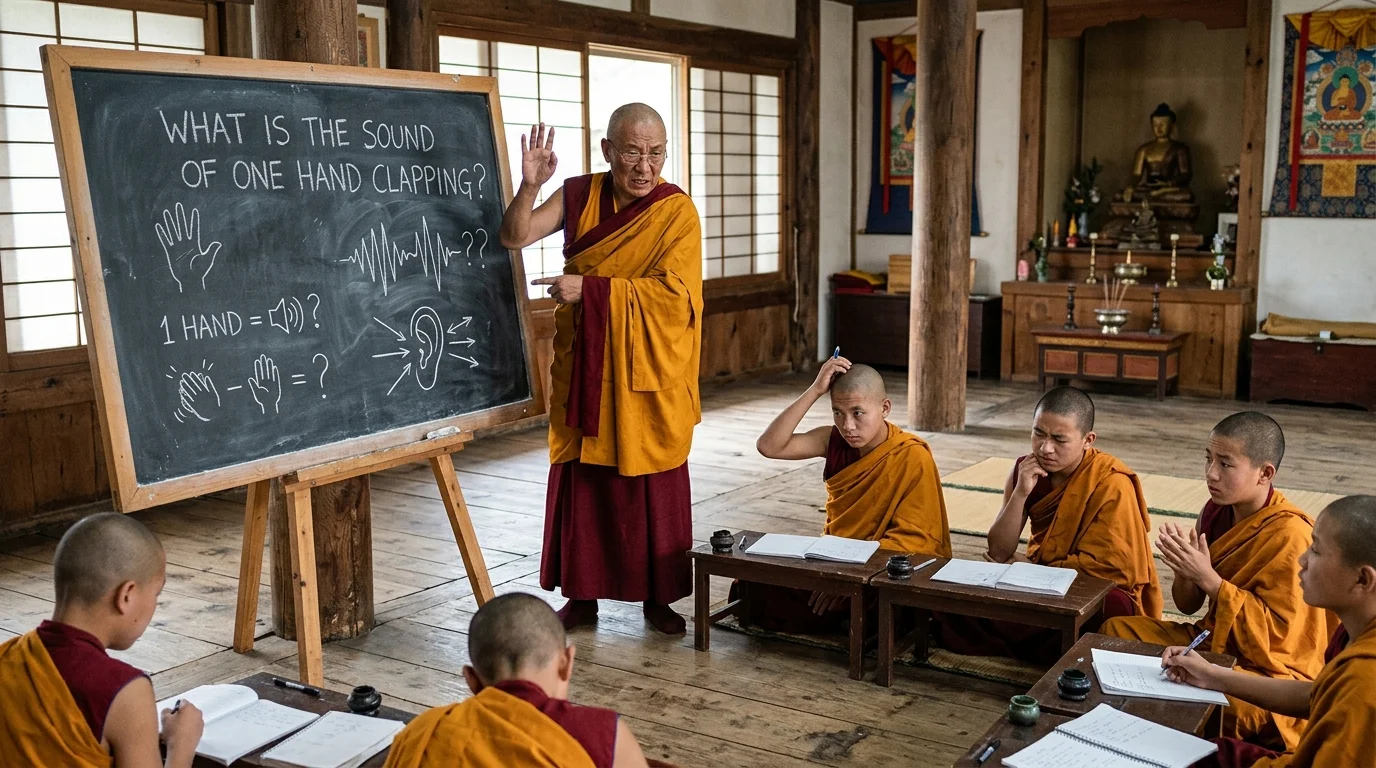
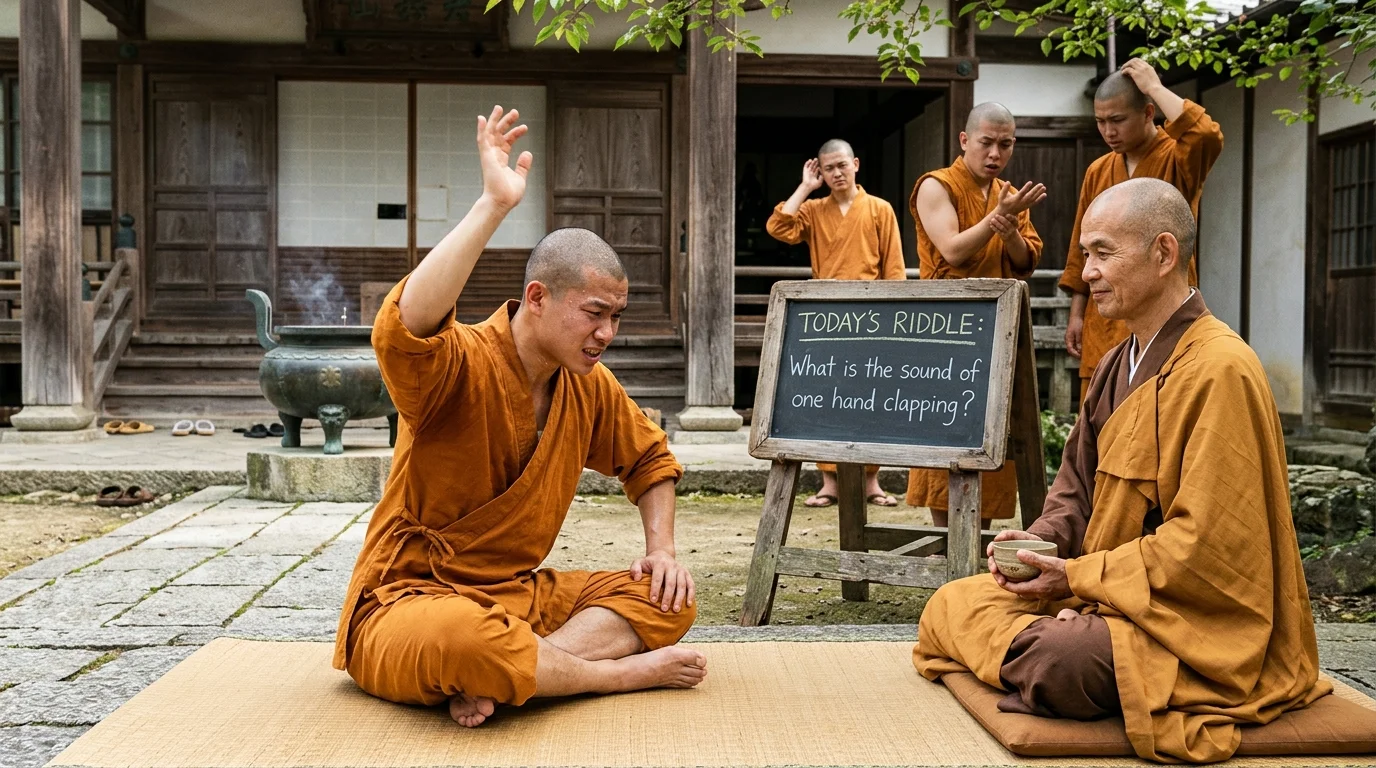
A student asks, “What is the sound of one hand?” Why is the question challenging? 👉 It interrupts ordinary assumptions about sound and action.
A teacher pours tea into a cup until it overflows. Why does he continue? 👉 To illustrate what happens when a mind is too full to receive anything new.
A monk asks, “If I let go of every thought, what remains?” What should he investigate? 👉 The awareness in which thoughts arise.
A student asks, “Where is the path?” The teacher points to the ground beneath their feet. What does this imply? 👉 Practice begins in the life you are living now.
A teacher asks, “Before you name the flower, what do you see?” What is the invitation? 👉 Experience something before concepts and labels take over.
Zen riddles with answers
I grow quiet when you listen closely, but I never truly disappear. What am I? 👉 The mind’s chatter.
I am always happening, yet you often miss me while thinking about yesterday and tomorrow. What am I? 👉 The present moment.
You can use me to see the world, but I can also distort what you see. What am I? 👉 The mind.
I am not a destination, but every mindful step can reveal me. What am I? 👉 The path.
I weigh nothing, yet holding on to me can feel exhausting. What am I? 👉 A grudge.
I cannot be collected in a jar or saved for later, but I can be experienced now. What am I? 👉 The present.
I appear when you stop demanding that life be different before you can be content. What am I? 👉 Acceptance.
I can be heard in a forest, a kitchen, or a crowded street, if you truly pay attention. What am I? 👉 The sounds of the moment.
I am like a mirror: I show what is there, but I do not need to keep it. What am I? 👉 Awareness.
I become clearer when you stop trying to force an answer. What am I? 👉 Insight.
Koan riddles
A student asks, “What is the way to wisdom?” The teacher replies, “Walk with your eyes open.” What does this mean? 👉 Pay attention to direct experience rather than relying only on ideas.
If a candle lights another candle, does the first flame become smaller? What might this question teach? 👉 Sharing wisdom does not necessarily diminish the one who shares it.
A monk asks, “Can a reflection cross a bridge?” What should he consider? 👉 The difference between an object and its image.
A teacher asks, “When a door is open, what makes it a doorway?” What is the puzzle? 👉 A doorway is understood through its function and relationship to what surrounds it.
A student says, “I have found the answer.” The teacher asks, “Can you put it down?” What is being tested? 👉 Whether the student is attached to being right.
A monk sees his face in still water, then sees it disappear when the water moves. What changed? 👉 The water’s condition, not the face itself.
A teacher asks, “What did your mind look like before your first thought today?” What is the student invited to explore? 👉 Awareness before labeling and judging experience.
A student asks, “How can I escape the noise of the world?” The teacher says, “First, listen to it.” What is the lesson? 👉 Understanding begins with attention, not avoidance.
A monk asks, “Is an empty room truly empty?” What might the question reveal? 👉 Even an apparently empty space has qualities, relationships, and possibilities.
A teacher asks, “If you stop searching for the road, where will your next step land?” What is the riddle about? 👉 The difference between endlessly seeking and actually practicing.
🧘 Buddhist Riddles About the Buddha
The Buddha is one of the central figures in Buddhist traditions, and stories about his life have inspired generations of art, teaching, reflection, and storytelling.
These riddles use familiar images and ideas associated with the Buddha while keeping the language simple and playful.
- I sat beneath a tree, yet traveled farther than most; my journey was inward, not across a road. 👉 The Buddha
- I am shown sitting peacefully, but my greatest journey was through understanding. Who am I? 👉 The Buddha
- I did not carry a sword to conquer the world; I taught a path toward conquering harmful desires. 👉 The Buddha
- Seek me in statues with peaceful faces, but remember that wisdom cannot be carved from stone alone. 👉 The Buddha
- Before I was called Buddha, I was a seeker searching for answers to life’s deepest questions. 👉 Siddhartha Gautama
- I am often pictured with calm eyes, reminding people to look closely at the mind. 👉 The Buddha
- I left royal comfort behind to search for a deeper answer to suffering and human life. 👉 Siddhartha Gautama
- My name can mean “awakened one,” but I am not a person who simply woke from an ordinary sleep. 👉 The Buddha
🌸 Buddhist Riddles About the Lotus Flower
The lotus is one of the best-known symbols in Buddhist art and culture. Its ability to rise above muddy water has made it a powerful image of beauty, growth, and spiritual development.
- My roots rest in muddy water, yet my flower rises clean and bright. 👉 The lotus
- I begin below the surface and reach upward toward the sun. 👉 The lotus
- Mud is beneath me, but you may admire my beauty above the water. 👉 The lotus flower
- I grow where the water is murky, yet my petals can look wonderfully pure. 👉 The lotus
- I remind people that difficult surroundings do not have to decide what they become. 👉 The lotus
- I wear many petals but have no coat, and I open toward the light without walking. 👉 The lotus
- A pond gives me a home, sunlight gives me warmth, and petals give me my famous shape. 👉 The lotus
- I am a flower often used in Buddhist art to represent spiritual growth and awakening. 👉 The lotus
🧠 Buddhist Riddles About Mindfulness and Meditation
Meditation and mindfulness are closely associated with many Buddhist traditions. These riddles turn attention toward quietness, awareness, breathing, and the present moment.
- I have no hands, yet I can be watched; I come and go all day without leaving the body. 👉 The breath
- The more quietly you notice me, the more clearly you may understand what is happening now. 👉 The present moment
- I do not need a television, book, or phone; I simply ask you to pay attention. 👉 Mindfulness
- I can sit without moving while thoughts come and go like clouds across the sky. 👉 A meditator
- I am not a race, and there is no finish line; I invite you to notice what is happening right now. 👉 Meditation
- I enter through your nose, leave through your nose or mouth, and can become an anchor for attention. 👉 The breath
- Thoughts may visit me, sounds may surround me, but I practice noticing without chasing every one. 👉 A mindful mind
- I become easier to notice when the room is quiet and attention is steady. 👉 The breath
☸️ Buddhist Riddles About the Dharma
In Buddhism, Dharma can refer to the Buddha’s teachings and the path of practice, although its meaning can vary by context and Buddhist tradition. These riddles use the term in that broad, familiar sense.
- I am not a road made of stones, yet I can guide someone toward wiser living. 👉 The Dharma
- You cannot put me in a suitcase, but you can study, practice, and reflect on me. 👉 The Dharma
- I am taught with words, understood through reflection, and explored through practice. 👉 The Dharma
- I am a teaching, not a treasure chest, yet I can be more valuable than gold to a seeker. 👉 The Dharma
- I may begin as something you hear, but understanding me requires more than simply listening. 👉 The Dharma
- I can point toward a path without carrying you along it. 👉 The Dharma
- I am often pictured with a wheel, but I am not something pulled by horses. 👉 The Dharma
- I invite questions, reflection, and practice rather than asking you to solve everything in one moment. 👉 The Dharma
🛞 Buddhist Riddles About the Dharma Wheel
The Dharma Wheel, often called the Dharmachakra, is one of the most recognizable Buddhist symbols. Its spokes and circular shape are commonly associated with the Buddha’s teachings and the path of practice.
- I have a round body and spokes, but I am not a bicycle wheel. 👉 The Dharma Wheel
- I can be carved in stone, painted on walls, or displayed in Buddhist art. 👉 The Dharma Wheel
- I have a center and spokes, but my purpose is symbolic rather than mechanical. 👉 The Dharma Wheel
- I turn without rolling across a road and represent teachings rather than transportation. 👉 The Dharma Wheel
- Travelers may carry wheels for vehicles, but mine points toward teachings and practice. 👉 The Dharma Wheel
- Count my spokes in a Buddhist image and you may be reminded of an important path of practice. 👉 The Dharma Wheel
- I am circular, balanced, and often seen beside Buddhist symbols. 👉 The Dharma Wheel
- A wheel usually carries a vehicle, but I symbolically carry an important teaching tradition. 👉 The Dharma Wheel
❤️ Buddhist Riddles About Compassion and Kindness
Compassion is an important theme in Buddhist teachings. These riddles turn kindness into simple puzzles that can work especially well for children, families, and classrooms.
- I cost nothing to give, yet can make another person’s difficult day lighter. 👉 Kindness
- I notice another person’s pain and wish to help rather than simply walk away. 👉 Compassion
- I grow when shared but never become smaller in your hands. 👉 Kindness
- I need no gift box, ribbon, or money, but a gentle action can carry me. 👉 Compassion
- I can begin with listening, continue with understanding, and finish with helpful action. 👉 Compassion
- I am small when whispered but can become powerful when someone truly needs encouragement. 👉 Kind words
- I do not require a throne or a crown; anyone can practice me in an ordinary moment. 👉 Kindness
- When someone is struggling, I look beyond judgment and ask, “How can I help?” 👉 Compassion
🌿 Buddhist Riddles About Karma and Cause and Effect
Karma is a rich and sometimes misunderstood Buddhist concept. In broad terms, Buddhist teachings connect karma with intentional actions and their consequences. These riddles focus on the simple idea that actions can have effects.
- I cannot be held in your hand, but intentional actions can set consequences in motion. 👉 Karma
- I remind you that what you choose to do can have results beyond the moment. 👉 Karma
- I am not a bag of coins or a magical scorecard, but I am connected with intentional action and its effects. 👉 Karma
- Plant an action like a seed, and consequences may grow from what was planted. What am I? 👉 Karma
- I follow choices rather than footsteps, and my story is about actions and their results. 👉 Karma
- I am often explained through cause and effect, especially when discussing intentional actions. 👉 Karma
- You cannot see me like a shadow, but my concept asks us to think carefully about what we do. 👉 Karma
- I encourage people to consider how intentions and actions can shape what follows. 👉 Karma
🕯️ Buddhist Riddles About Wisdom and Enlightenment
Many Buddhist traditions place great importance on wisdom and awakening. These riddles use light, seeing, understanding, and awakening as playful images.
- I am not a lamp, but I can brighten a confused mind. 👉 Wisdom
- I cannot be bought at a store, yet careful learning and practice can help develop me. 👉 Wisdom
- I arrive when confusion fades and understanding becomes clearer. 👉 Insight
- I have no physical shape, but I can change the way you understand a problem. 👉 Wisdom
- I am sometimes compared with light because I help reveal what was difficult to see. 👉 Wisdom
- I am an awakening, but not the kind that comes from an alarm clock. 👉 Enlightenment
- The more clearly you see things as they are, the closer you may come to understanding me. 👉 Insight
- I do not make a room brighter, but I can make a person’s understanding brighter. 👉 Wisdom
🏯 Buddhist Riddles About Temples, Stupas, and Sacred Places
Buddhist communities around the world have built temples, monasteries, stupas, meditation centers, and other places for practice, learning, remembrance, and community.
- I may have bells, statues, gardens, or quiet halls, but I am built as a place for Buddhist practice and community. 👉 A Buddhist temple
- I can be a peaceful place where people meditate, learn, gather, or reflect. 👉 A Buddhist temple
- I may look like a rounded monument and can hold important Buddhist meaning. 👉 A stupa
- I stand quietly while visitors walk around me with respect. 👉 A stupa
- I am not always a home, but monks and nuns may live and practice within my peaceful surroundings. 👉 A Buddhist monastery
- I can contain paintings, sculptures, books, and spaces for meditation. 👉 A Buddhist temple
- I have no classroom bell, yet people may come to me to learn. 👉 A Buddhist monastery
- I can be ancient or modern, large or small, but my purpose can include reflection and Buddhist practice. 👉 A Buddhist temple
🔔 Buddhist Riddles About Bells, Incense, and Peaceful Symbols
Buddhist cultures use many objects in art and religious practice. Their meanings and uses can differ between traditions, so these riddles focus on familiar symbolic imagery rather than suggesting one universal practice.
- I make no speech, yet my gentle sound can fill a quiet temple. 👉 A bell
- I rise instead of falling, carrying a fragrance through the air. 👉 Incense smoke
- I may be tiny, but my sound can travel through a peaceful room. 👉 A bell
- I disappear as I burn while leaving a pleasant fragrance behind. 👉 Incense
- I have no mouth, yet I can sing when someone strikes or moves me. 👉 A bell
- I begin as something solid, then become a curling trail that floats upward. 👉 Incense smoke
- I am often associated with quiet spaces, but I am not silence itself. 👉 A temple bell
- I am seen in some Buddhist settings as a fragrant offering, though practices vary across traditions. 👉 Incense
☯️ Buddhist Riddles About the Four Noble Truths and the Eightfold Path
The Four Noble Truths and Noble Eightfold Path are central frameworks in Buddhist teachings. These riddles simplify the ideas for puzzle play without trying to replace serious study.
- I describe a truth about unsatisfactoriness and suffering rather than pretending life has no difficulties. 👉 The First Noble Truth
- I ask what gives rise to suffering and points toward its causes. 👉 The Second Noble Truth
- I offer the possibility of the ending of suffering. 👉 The Third Noble Truth
- I point toward a path of practice rather than promising an effortless shortcut. 👉 The Fourth Noble Truth
- I am called a path, but I have no pavement, road signs, or traffic lights. 👉 The Noble Eightfold Path
- I include right speech, right action, and right livelihood among other forms of practice. 👉 The Noble Eightfold Path
- I am not eight roads crossing a mountain; I describe interconnected areas of Buddhist practice. 👉 The Noble Eightfold Path
- I help organize important Buddhist teachings into a framework for understanding and practice. 👉 The Four Noble Truths
🌏 Buddhist Riddles About Buddhist Culture and Traditions
Buddhism has developed across many regions, including South Asia, East Asia, Southeast Asia, the Himalayas, and beyond. Different Buddhist traditions have their own languages, customs, art, ceremonies, and practices.
- I may be orange, maroon, gray, or another color depending on the Buddhist community. 👉 Monastic robes
- I can hang in the wind and carry prayers or sacred words in some Himalayan Buddhist traditions. 👉 Prayer flags
- I may be held while walking or standing and contain repeated sacred syllables or mantras. 👉 A prayer wheel
- I am a circular object that can be turned by hand in some Tibetan Buddhist practices. 👉 A prayer wheel
- I may cover a monk or nun from shoulder to ankle, depending on tradition and robe style. 👉 A monastic robe
- I can be painted with intricate Buddhist images and is especially associated with Himalayan traditions. 👉 A thangka
- I am made of many colors and may appear on mountainsides or near Buddhist sites in Himalayan regions. 👉 Prayer flags
- I can be a place of study, meditation, community, and monastic life. 👉 A monastery
👧 Buddhist Riddles for Kids
Young puzzle-solvers often enjoy riddles that use familiar objects and simple clues. These Buddhist-inspired riddles introduce concepts such as kindness, calmness, and mindfulness through playful language.
- I am soft, peaceful, and often shown growing from a pond. 👉 A lotus
- I help you notice your breathing when you sit quietly. 👉 Mindfulness
- I have petals but cannot walk, and I can rise from muddy water. 👉 A lotus
- I make a gentle sound in a quiet temple when I am struck. 👉 A bell
- I am something you can give without taking it from a shelf. 👉 Kindness
- I sit quietly and pay attention instead of rushing around the room. 👉 A meditator
- I am a round symbol with spokes that represents Buddhist teachings. 👉 The Dharma Wheel
- I am the feeling that makes you want to help someone who is hurting. 👉 Compassion
- I can be practiced while eating, walking, breathing, or listening carefully. 👉 Mindfulness
- I am an important Buddhist figure often shown sitting peacefully beneath a tree. 👉 The Buddha
👨👩👧 Buddhist Riddles for Families and Adults
These riddles are slightly more reflective. Use them at home, during a discussion group, in a classroom, or as a quiet challenge between friends.
- I ask you to notice a thought without automatically believing or following it. 👉 Mindfulness
- I am a journey that may happen without taking a single physical step. 👉 Inner practice
- I can turn a difficult experience into an opportunity for reflection and understanding. 👉 Wisdom
- I am not the absence of every thought, but the practice of observing experience with attention. 👉 Mindfulness
- I may be difficult to see, yet my effects can appear through choices, habits, and consequences. 👉 Karma
- I ask you to respond to suffering with care instead of indifference. 👉 Compassion
- I am a teaching path that connects understanding, conduct, and mental cultivation. 👉 The Noble Eightfold Path
- I cannot be found simply by collecting possessions, because my value belongs to understanding rather than ownership. 👉 Wisdom
- I am a peaceful pause between reacting and choosing what to do next. 👉 Mindfulness
- I grow when curiosity meets careful attention and reflection. 👉 Understanding
🎓 Buddhist Riddles for Classrooms and Teachers
Riddles can make lessons interactive. Teachers can use them as warm-up activities, vocabulary games, discussion starters, or short reflection exercises.
- I am a word often translated as “awakened one,” referring to someone who has awakened to profound understanding. 👉 Buddha
- I am the community of Buddhist practitioners, traditionally including monks and nuns as well as other followers. 👉 Sangha
- I am the teaching associated with the Buddha and the path of Buddhist practice. 👉 Dharma
- I am the practice of paying careful attention to present experience. 👉 Mindfulness
- I am a flower whose growth from muddy water makes it a powerful Buddhist symbol. 👉 Lotus
- I am a wheel-shaped Buddhist symbol associated with the Buddha’s teachings. 👉 Dharma Wheel
- I am a place where Buddhist monks or nuns may live, study, meditate, and practice. 👉 Monastery
- I describe intentional actions and their consequences in Buddhist thought. 👉 Karma
- I am the quality that responds to suffering with a wish to help. 👉 Compassion
- I am the cultivation of clear understanding and discernment. 👉 Wisdom