
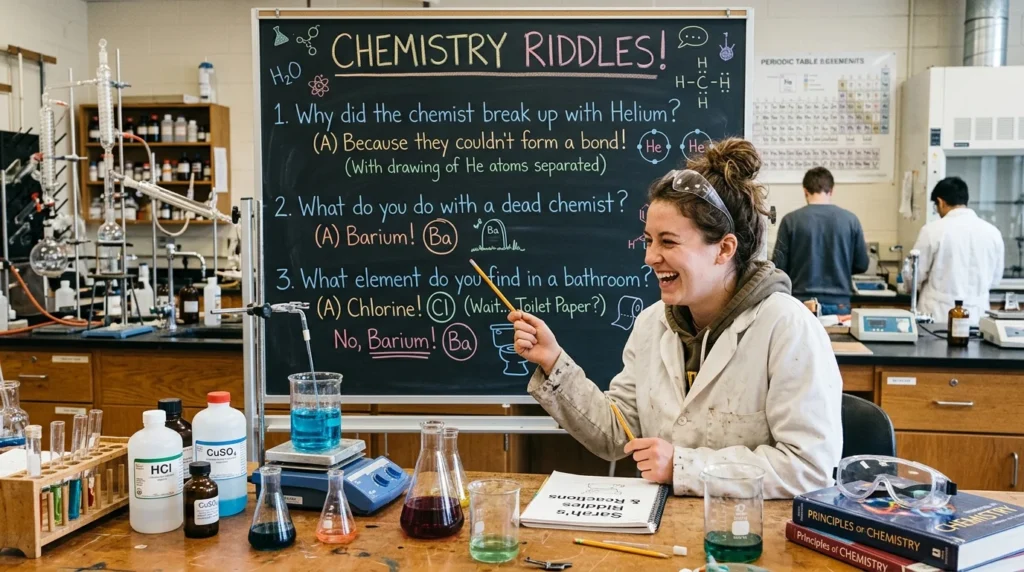
Chemistry Riddles with answers pdf
These chemistry riddles with answers are provided in text format, making them easy to copy into a worksheet or save as a PDF for classroom activities, science clubs, or study sessions.
I am the smallest unit of an element that keeps its chemical identity. What am I? 👉 An atom.
I have a positive charge and live inside an atom’s nucleus. What am I? 👉 A proton.
I have a negative charge and move around an atom’s nucleus. What am I? 👉 An electron.
I am made of two hydrogen atoms and one oxygen atom, and I am essential for life. What am I? 👉 Water (H₂O).
I speed up a chemical reaction without being permanently consumed. What am I? 👉 A catalyst.
I have a pH below 7 and can react with certain metals. What am I? 👉 An acid.
I have a pH above 7 in aqueous solution and can neutralize an acid. What am I? 👉 A base.
I am a substance made of two or more elements chemically bonded together. What am I? 👉 A compound.
I am the chart that organizes elements by atomic number and recurring properties. What am I? 👉 The periodic table.
I am the process in which a liquid changes into a gas at its surface. What am I? 👉 Evaporation.
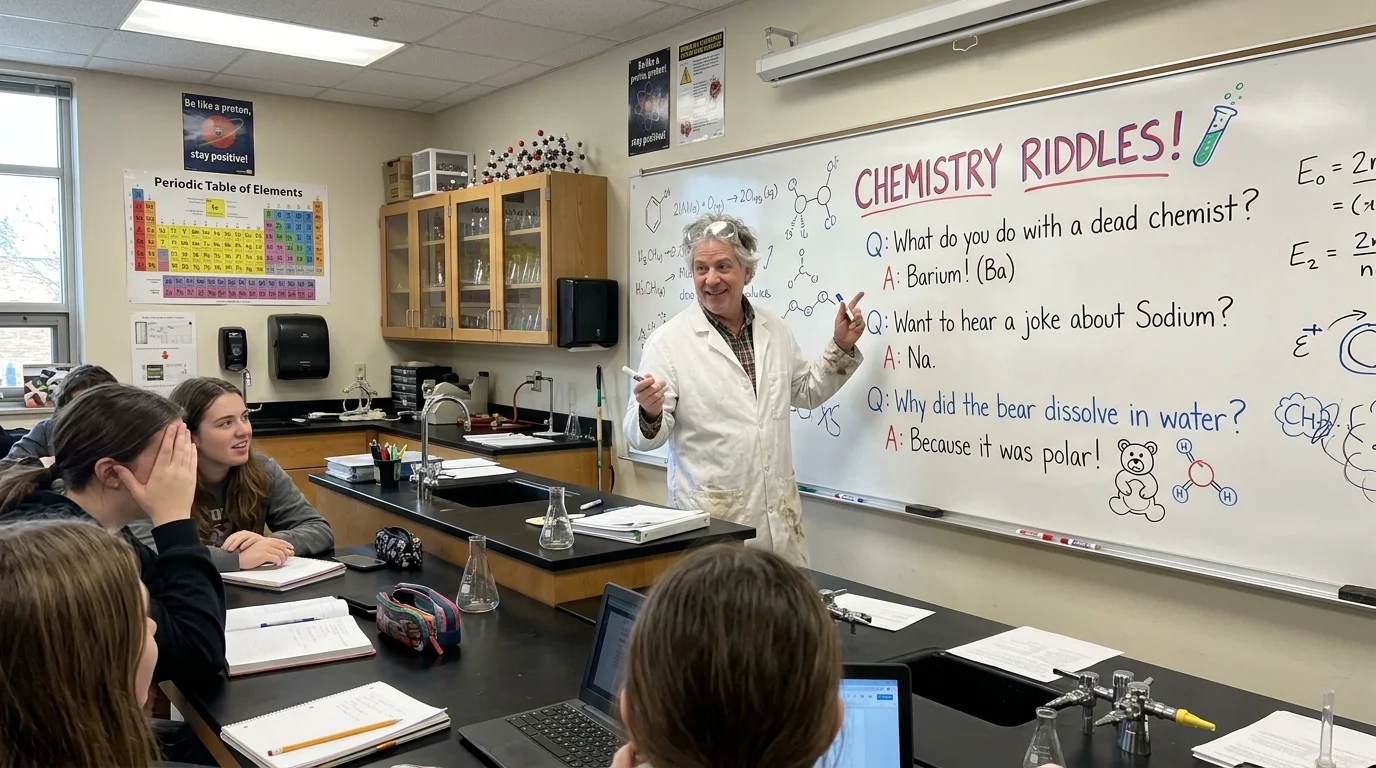
Chemistry riddles with answers
I am everywhere around you, yet you cannot see me. I contain nitrogen, oxygen, and other gases. What am I? 👉 Air.
I am a shiny metal, and my chemical symbol is Fe. What am I? 👉 Iron.
I help keep bones and teeth strong, and my chemical symbol is Ca. What am I? 👉 Calcium.
I am a gas that plants take in during photosynthesis. What am I? 👉 Carbon dioxide.
I am the number of protons in an atom’s nucleus. What am I called? 👉 The atomic number.
I form when an atom gains or loses electrons and becomes electrically charged. What am I? 👉 An ion.
I am a reaction that releases energy, often as heat. What am I? 👉 An exothermic reaction.
I am the separation of a substance into simpler substances through a chemical change. What am I? 👉 Chemical decomposition.
I am the chemical bond formed when atoms share electron pairs. What am I? 👉 A covalent bond.
I am the chemical bond formed through attraction between oppositely charged ions. What am I? 👉 An ionic bond.
Hard chemistry riddles
I have 17 protons, usually 18 electrons when I become an ion, and I am famous for disinfecting swimming pools. What am I? 👉 Chlorine in its chloride ion form (Cl⁻).
I am a particle with the same number of protons as another atom but a different number of neutrons. What am I? 👉 An isotope.
I am a reaction in which electrons are transferred between substances. What am I? 👉 A redox reaction.
I can act as both an acid and a base, depending on what I react with. What am I called? 👉 An amphoteric substance.
I describe how much solute is dissolved in a given amount of solution. What am I? 👉 Concentration.
I measure the energy needed to remove an electron from a gaseous atom. What am I? 👉 Ionization energy.
I am the amount of substance containing approximately (6.022 \times 10^{23}) specified particles. What am I? 👉 A mole.
I resist changes in pH when small amounts of acid or base are added. What am I? 👉 A buffer solution.
I describe the three-dimensional arrangement of atoms in a molecule. What am I? 👉 Molecular geometry.
I am the minimum energy needed for a chemical reaction to proceed through its transition state. What am I? 👉 Activation energy.
Chemistry riddles periodic table
My symbol is H, and I am the lightest element. Who am I? 👉 Hydrogen.
My symbol is Au, and people have valued me for jewelry and coins for thousands of years. Who am I? 👉 Gold.
My symbol is Na, and I combine with chlorine to form common table salt. Who am I? 👉 Sodium.
My symbol is O, and many living organisms need me for aerobic respiration. Who am I? 👉 Oxygen.
My symbol is C, and I form the backbone of most molecules in living things. Who am I? 👉 Carbon.
My symbol is He, and I am a noble gas often used to fill balloons. Who am I? 👉 Helium.
My symbol is Ag, and I am a precious metal used in jewelry and electronics. Who am I? 👉 Silver.
My symbol is K, and my name comes from the Latin word kalium. Who am I? 👉 Potassium.
My symbol is Fe, and I am an important component of steel. Who am I? 👉 Iron.
My symbol is Ne, and I can produce a bright reddish-orange glow in a discharge tube. Who am I? 👉 Neon.
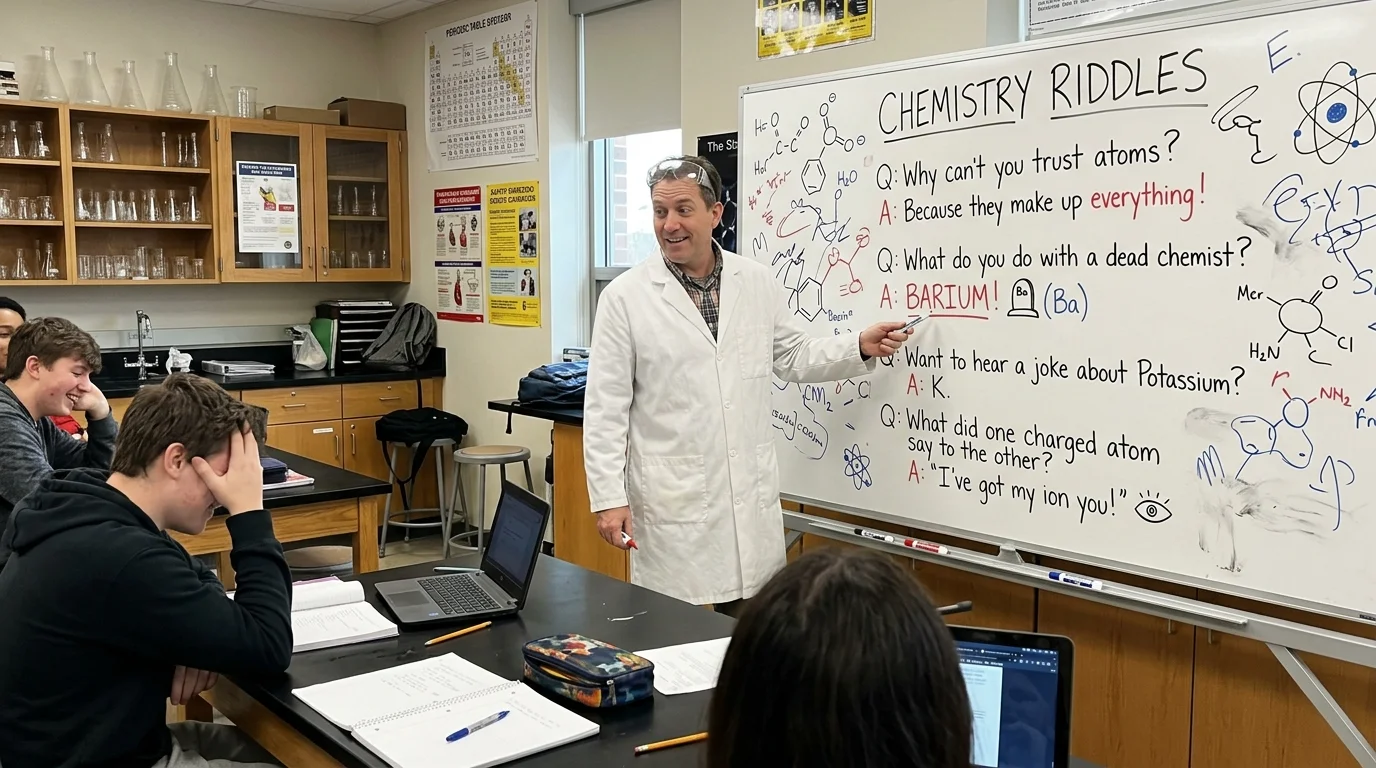
Chemistry riddles and jokes
Why was the chemistry book always worried? 👉 It had too many problems to solve.
What did one atom say after losing an electron? 👉 “I’m feeling positive!”
Why did the chemist bring a ladder to the lab? 👉 To reach the higher energy levels.
What do you call an iron atom that has lost two electrons? 👉 Fe²⁺, an iron(II) ion.
Why did the acid stop arguing with the base? 👉 They decided to neutralize the tension.
Why are chemists great at solving mysteries? 👉 They know how to examine the evidence and identify the elements.
What did the chemist say when the reaction worked perfectly? 👉 “That’s a positive result!”
Why did the noble gas avoid the party? 👉 It preferred not to react.
What is a chemist’s favorite kind of joke? 👉 One with a good reaction.
Why did the molecule break up with its partner? 👉 It felt they had lost their bond.
Chemistry riddles for adults
I can be solid, liquid, or gas, yet my particles never stop moving. What am I? 👉 Matter.
I describe the tendency of an atom to attract shared electrons in a chemical bond. What am I? 👉 Electronegativity.
I am the point at which the forward and reverse reaction rates are equal, so concentrations remain constant. What am I? 👉 Chemical equilibrium.
I measure the energy change when a reaction occurs at constant pressure. What am I? 👉 Enthalpy change.
I am a substance that donates a proton in the Brønsted–Lowry model. What am I? 👉 An acid.
I am a substance that accepts a proton in the Brønsted–Lowry model. What am I? 👉 A base.
I am the electrode where oxidation occurs, whether in a galvanic cell or an electrolytic cell. What am I? 👉 The anode.
I am the electrode where reduction occurs in an electrochemical cell. What am I? 👉 The cathode.
I describe how quickly reactants are converted into products. What am I? 👉 Reaction rate.
I am a measure of how strongly a solution resists changes in acidity or alkalinity. What am I? 👉 Buffer capacity.
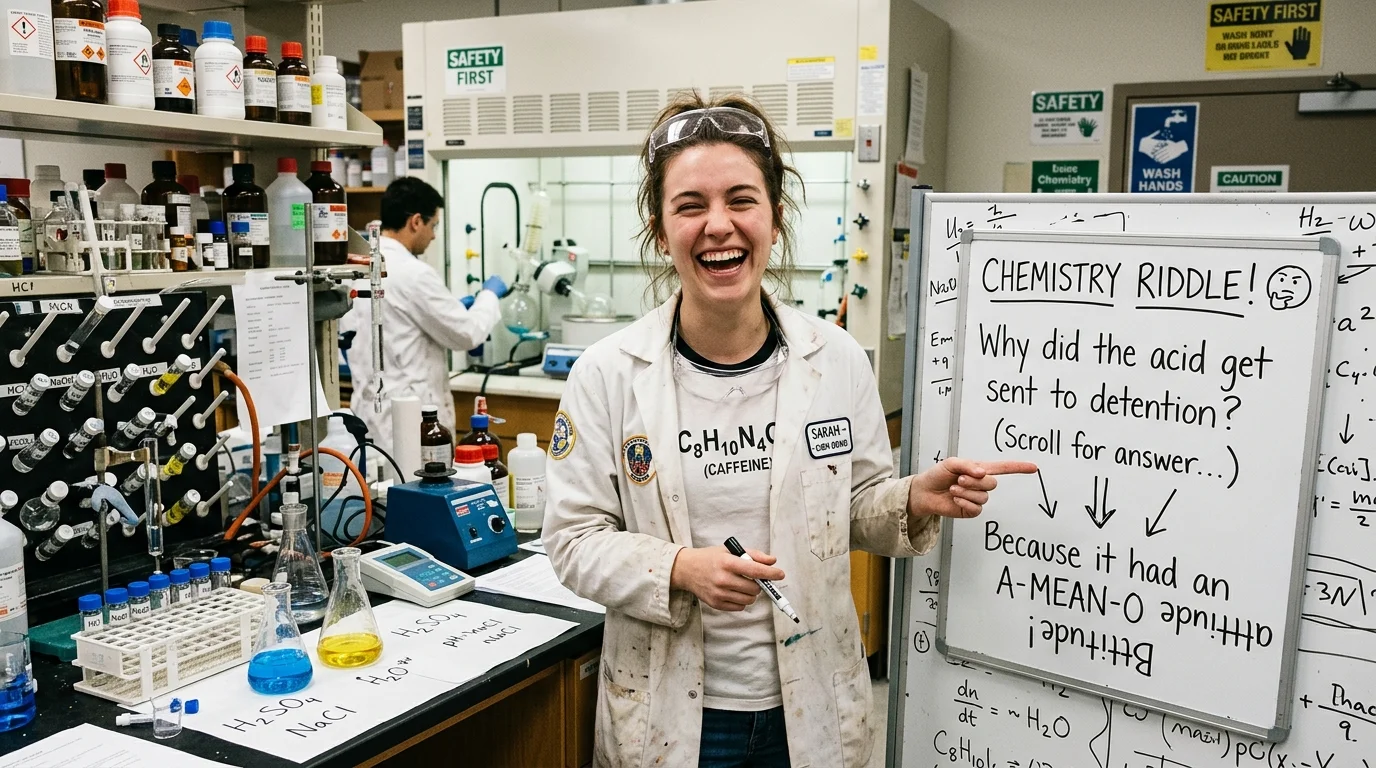
⚛️ Atom Riddles
- I am the tiny building block of all matter. 👉 Atom
- I have a center filled with protons and neutrons. 👉 Nucleus
- I move around the nucleus but weigh very little. 👉 Electron
- My positive charge balances the negative ones. 👉 Proton
- I have no electrical charge at all. 👉 Neutron
- I determine which element something is. 👉 Number of protons
- I am too small to see without powerful tools. 👉 Atom
- I help create every molecule in the universe. 👉 Atom
- I stay at the center of an atom. 👉 Nucleus
- I help make chemistry possible. 👉 Atoms
🧪 Laboratory Riddles
- Scientists wear me to protect their eyes. 👉 Safety goggles
- I hold bubbling liquids during experiments. 👉 Beaker
- I measure liquids carefully. 👉 Graduated cylinder
- I help mix chemicals safely. 👉 Test tube
- I protect hands from chemicals. 👉 Laboratory gloves
- I help heat substances in science labs. 👉 Bunsen burner
- I tell you how hot something is. 👉 Thermometer
- I hold tiny amounts of liquid. 👉 Dropper
- I help scientists make careful observations. 👉 Microscope
- I keep experiments organized. 👉 Laboratory notebook
🌡️ States of Matter Riddles
- I keep my shape unless someone breaks me. 👉 Solid
- I flow and fill the bottom of a container. 👉 Liquid
- I spread out to fill every corner. 👉 Gas
- I become steam when heated enough. 👉 Water vapor
- I freeze into something hard and cold. 👉 Ice
- I melt when the temperature rises. 👉 Solid
- I change form without changing what I’m made of. 👉 Matter
- I can be poured but not stacked. 👉 Liquid
- I move freely through the air. 👉 Gas
- I exist in many forms around us. 👉 Matter
🧬 Element Riddles
- I am the lightest element in the universe. 👉 Hydrogen
- People breathe me every second. 👉 Oxygen
- I help pencils leave their marks. 👉 Carbon
- I fill colorful party balloons. 👉 Helium
- I sparkle as precious jewelry. 👉 Gold
- I shine with a silver-gray appearance and attract magnets. 👉 Iron
- I season many favorite meals. 👉 Sodium
- I help bones stay strong. 👉 Calcium
- I glow brightly inside old-fashioned signs. 👉 Neon
- I make up much of the air around us. 👉 Nitrogen
💧 Everyday Chemistry Riddles
- I quench your thirst and cover most of Earth. 👉 Water
- I make bubbles in many soft drinks. 👉 Carbon dioxide
- I sweeten desserts and drinks. 👉 Sugar
- I dissolve in water and flavor your food. 👉 Salt
- I help wash away dirt. 👉 Soap
- I brighten your smile every morning. 👉 Toothpaste
- I helps plants grow strong. 👉 Fertilizer
- I fizz when mixed into certain drinks. 👉 Baking soda
- I cool your favorite frozen treats. 👉 Ice
- I help bake fluffy cakes. 👉 Baking powder
🔥 Chemical Reaction Riddles
- I happen when substances become something new. 👉 Chemical reaction
- I appear when iron slowly changes color. 👉 Rust
- I glow with heat during burning. 👉 Fire
- I create bubbles when gases are released. 👉 Reaction
- I happen when vinegar meets baking soda. 👉 Fizzy reaction
- I release energy as I burn. 👉 Combustion
- I change ingredients into delicious bread. 👉 Baking
- I happen all around you every day. 👉 Chemical reactions
- I can produce light, heat, or gas. 👉 Chemical reaction
- I help transform one substance into another. 👉 Chemistry
🧠 Challenging Chemistry Riddles
- I organize every known element into neat rows and columns. 👉 Periodic table
- I cannot be seen, yet I build mountains, oceans, and stars. 👉 Atom
- I connect atoms together like invisible bridges. 👉 Chemical bond
- I become stronger when many atoms join together. 👉 Molecule
- I keep the universe full of endless possibilities. 👉 Elements
- I may look ordinary, but I am full of tiny moving particles. 👉 Matter
- I never stop changing, even when you cannot see it. 👉 Chemistry
- I explain why leaves change color and bread rises. 👉 Chemical reactions
- I help scientists understand the world one experiment at a time. 👉 Science
- I prove that even the smallest things can make the biggest difference. 👉 Atom