
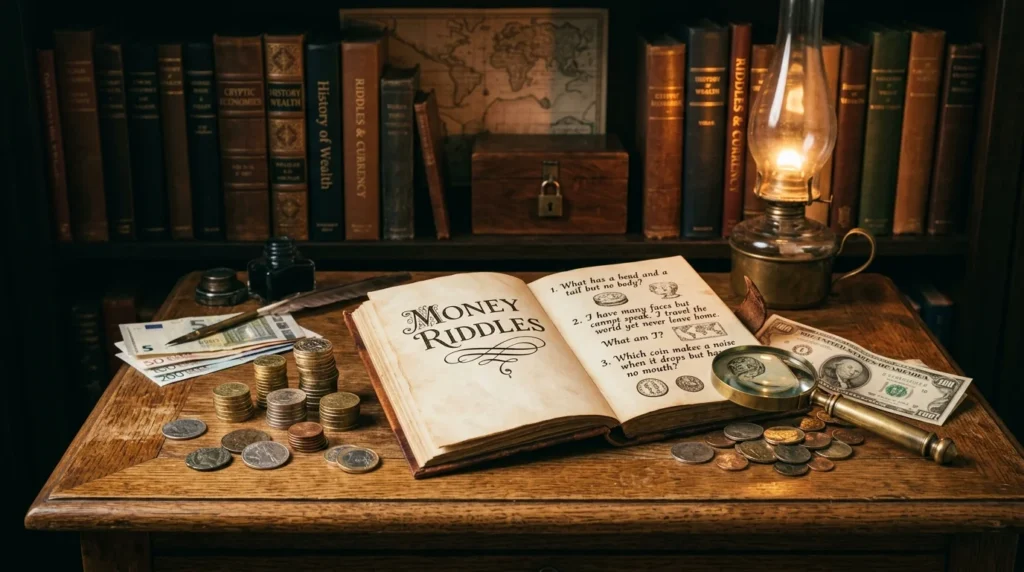
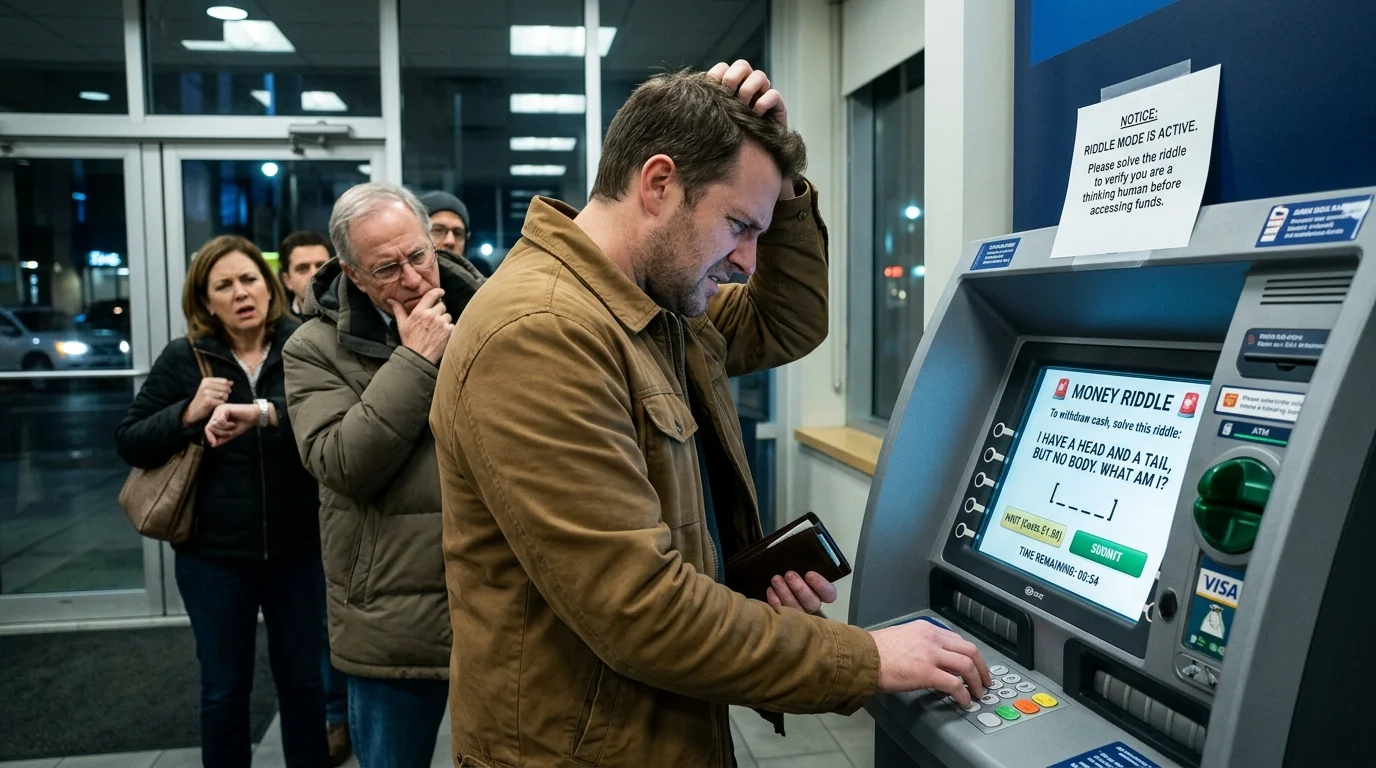
Money riddles with answers
Riddle: I come in coins and bills. You can earn me, save me, or spend me. What am I?
👉 Answer: Money.Riddle: I have a face and a number, but I cannot smile or count. You might find me in your pocket. What am I?
👉 Answer: A coin.Riddle: The more you save me, the more you have for later. What am I?
👉 Answer: Savings.Riddle: I can buy a book but cannot read it. I can buy a ball but cannot play with it. What am I?
👉 Answer: Money.Riddle: I am often made of paper, carry a printed value, and can pay for things. What am I?
👉 Answer: A banknote.Riddle: I can be full of money, yet I have no pockets. People use me to keep their cash safe. What am I?
👉 Answer: A wallet.Riddle: You give me to a shopkeeper when you buy something, and you receive goods in return. What am I?
👉 Answer: Payment.Riddle: I grow when you add money and shrink when you take money away. What am I?
👉 Answer: A bank balance or savings balance.Riddle: I am not a gift, but I can make people happy when payday arrives. What am I?
👉 Answer: A paycheck.Riddle: I have a price, but I am not money. I tell you how much you need to pay. What am I?
👉 Answer: A price tag.
Money riddles for students
Riddle: Sara has 4 coins worth $1 each. How much money does she have?
👉 Answer: $4.Riddle: You have $20 and spend $7 on lunch. How much money remains?
👉 Answer: $13.Riddle: A pencil costs $2. How much will 5 pencils cost?
👉 Answer: $10.Riddle: Alex saves $3 every week. How much will Alex save in 8 weeks if no money is spent?
👉 Answer: $24.Riddle: Three friends each contribute $5 toward a gift. What is their total contribution?
👉 Answer: $15.Riddle: A notebook costs $6, and a pen costs $2. How much do both items cost together?
👉 Answer: $8.Riddle: Mia has $50. She buys a game for $32. How much does she have left?
👉 Answer: $18.Riddle: You have two $10 bills and three $1 bills. How much money do you have?
👉 Answer: $23.Riddle: A toy costs $18. You pay with a $20 bill. How much change should you receive?
👉 Answer: $2.Riddle: Ben saves $4 on Monday, $6 on Tuesday, and $5 on Wednesday. How much does he save altogether?
👉 Answer: $15.
Money riddles for kids
Riddle: I am round, sometimes shiny, and I can be worth one cent or more. What am I?
👉 Answer: A coin.Riddle: I help you carry your lunch money, but I am not a lunchbox. What am I?
👉 Answer: A wallet or coin purse.Riddle: You put money inside me and break me open when you want to use your savings. What am I?
👉 Answer: A piggy bank.Riddle: I am something you might receive for doing chores or helping at home. What am I?
👉 Answer: An allowance.Riddle: I am a place where you can buy candy, toys, and books. You usually need money to shop here. What am I?
👉 Answer: A store.Riddle: I am money you keep instead of spending right away. What am I?
👉 Answer: Savings.Riddle: I tell you how much a toy costs before you buy it. What am I?
👉 Answer: A price tag.Riddle: I am money returned to you when you pay more than the price of an item. What am I?
👉 Answer: Change.Riddle: I may be given on a birthday or holiday, and you can save me for something special. What am I?
👉 Answer: Money as a gift.Riddle: I have a slot for coins and a place to keep bills. You might take me shopping. What am I?
👉 Answer: A wallet.
Money riddles with answers for kids
Riddle: Lily has 2 quarters. How much money does she have?
👉 Answer: 50 cents.Riddle: One apple costs $1. How much do 3 apples cost?
👉 Answer: $3.Riddle: You have 10 coins worth $1 each and give 4 away. How many dollars do you have left?
👉 Answer: $6.Riddle: A sticker costs 25 cents. How much do 4 stickers cost?
👉 Answer: $1.Riddle: Sam has $5 and earns another $2. How much money does he have now?
👉 Answer: $7.Riddle: You buy a cookie for $2 and pay with $5. How much change should you get?
👉 Answer: $3.Riddle: A toy costs $12. You have saved $9. How much more do you need?
👉 Answer: $3.Riddle: Emma puts $2 into her piggy bank every day for 5 days. How much does she save?
👉 Answer: $10.Riddle: You have one $5 bill and two $1 bills. How much money do you have?
👉 Answer: $7.Riddle: A book costs $8. You have a $10 bill. Can you buy it, and how much will remain?
👉 Answer: Yes. You will have $2 left.
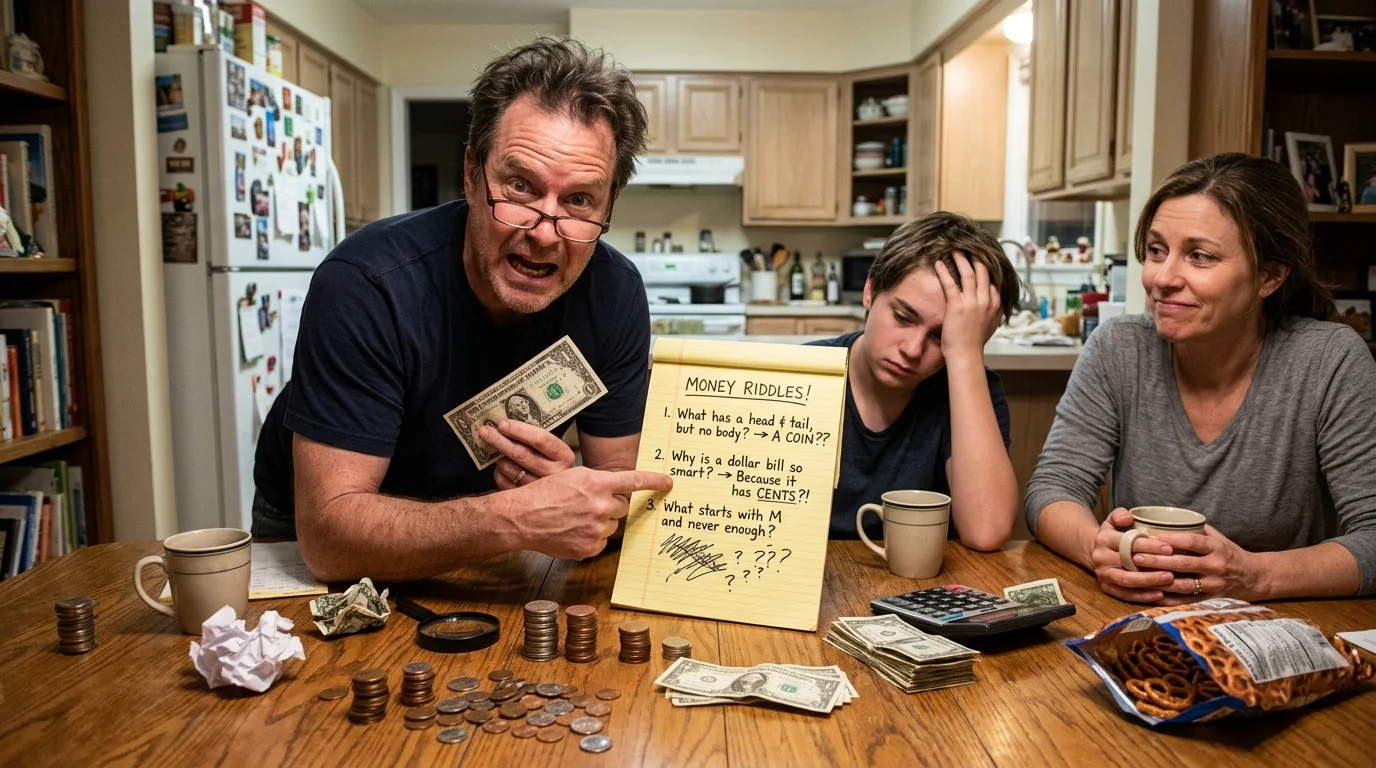
Money riddles for adults
Riddle: I can make life easier, but chasing me can make life harder. I can be earned, invested, or lost. What am I?
👉 Answer: Money.Riddle: I am money set aside for unexpected expenses, not for a holiday or a new television. What am I?
👉 Answer: An emergency fund.Riddle: I can grow while you sleep, but I may also lose value. I often require patience and risk. What am I?
👉 Answer: An investment.Riddle: The more you borrow, the more of me you may owe. I can accumulate over time. What am I?
👉 Answer: Interest.Riddle: I am the plan that tells every dollar where to go before the month begins. What am I?
👉 Answer: A budget.Riddle: I am the difference between what you earn and what you spend. Keep me positive, and you can build savings. What am I?
👉 Answer: A surplus.Riddle: I can be paid monthly, but I am not a subscription. I help you repay money borrowed to buy a home or car. What am I?
👉 Answer: A loan installment.Riddle: I am money you owe, even if you would rather not think about me. What am I?
👉 Answer: Debt.Riddle: I measure how much your money can buy, not just how many dollars you have. What am I?
👉 Answer: Purchasing power.Riddle: I am the money left after expenses are paid, and I can help you reach future goals. What am I?
👉 Answer: Disposable income or money available to save, depending on which expenses have been counted.
Money riddle missing dollar
The missing-dollar riddle is a classic brain teaser about misleading arithmetic. The trick is that the final calculation combines amounts that should not be added together.
Riddle:
Three friends rent a hotel room for $30. Each friend pays $10.
Later, the hotel discovers that the room should have cost only $25. The hotel gives a bellhop $5 to return to the friends.
On the way, the bellhop decides to keep $2 and gives each friend $1 back.
Each friend has now paid $9, so the three friends have paid $27 altogether. The bellhop kept $2.
That makes $29. Where did the missing dollar go?
👉 Answer: No dollar is missing. The mistake is adding the bellhop’s $2 to the friends’ $27.
The correct accounting is:
The friends originally paid: $30
The friends received back: $3
The hotel kept: $25
The bellhop kept: $2
So, $25 + $2 + $3 = $30.
The friends’ net payment of $27 already includes the $2 kept by the bellhop: $25 went to the hotel and $2 went to the bellhop. You should not add the $2 to $27 again.
Bank riddles with answers
Riddle: I keep your money safe, help you make payments, and may lend you money. What am I?
👉 Answer: A bank.Riddle: I show how much money you have in your bank account. What am I?
👉 Answer: An account balance.Riddle: I let you take cash from a machine using a card and a personal identification number. What am I?
👉 Answer: An ATM withdrawal.Riddle: I am a card you can use to spend money already in your bank account. What am I?
👉 Answer: A debit card.Riddle: I am money a bank pays you for keeping eligible savings with it. What am I?
👉 Answer: Interest.Riddle: I move money from one bank account to another without handing over cash. What am I?
👉 Answer: A bank transfer.Riddle: I am a record of money entering and leaving your account. What am I?
👉 Answer: A bank statement or transaction history.Riddle: I am a promise to repay money that a bank lends you, usually under agreed terms. What am I?
👉 Answer: A loan.Riddle: I can block a purchase if your account does not have enough available money. What am I?
👉 Answer: An insufficient-funds check or account restriction, depending on the bank and transaction.Riddle: I am a secret number used to help verify your identity when using certain banking services. What am I?
👉 Answer: A PIN.
Hard money riddles
Riddle: I have three coins in my pocket. Together, they total 30 cents. One of them is not a nickel. What are the coins?
👉 Answer: A quarter and two nickels would total 35 cents, so that is not correct. The intended classic version uses two coins totaling 30 cents, one of which is not a nickel: a quarter and a nickel. For this three-coin version, there is no solution using standard U.S. coins because no three standard coins total exactly 30 cents.Riddle: A person has $100. They spend half of what they have, then spend half of what remains. How much money is left?
👉 Answer: $25. After spending $50, $50 remains; after spending half of that, $25 remains.Riddle: A wallet contains only $5 bills and $10 bills. There are 6 bills worth $45 in total. How many of each bill are there?
👉 Answer: Three $5 bills and three $10 bills would total $45, but that is 6 bills: $15 + $30 = $45. So there are three of each.Riddle: You have a $20 bill and exchange it for smaller bills. You receive 8 bills, all worth either $1 or $5. How many $5 bills do you receive?
👉 Answer: Three $5 bills and five $1 bills: $15 + $5 = $20, and there are 8 bills.Riddle: You save $1 on the first day, $2 on the second, $3 on the third, and continue adding one dollar each day. How much will you save over 10 days?
👉 Answer: $55, because $1 + $2 + $3 + … + $10 = $55.Riddle: A shop reduces an item’s price by 20%, then reduces the new price by another 20%. Is the total reduction 40%?
👉 Answer: No. If the original price is $100, the first reduction makes it $80. The second reduction is 20% of $80, or $16, leaving $64. The total reduction is 36%.Riddle: You lend a friend $50 and they repay $20. Then you lend them another $10. How much do they owe you now?
👉 Answer: $40. They owed $50, repaid $20, and borrowed another $10: $50 − $20 + $10 = $40.Riddle: A person has $100 and spends 10% of it. They then spend 10% of the money left. How much remains?
👉 Answer: $81. The first purchase leaves $90; 10% of $90 is $9, leaving $81.Riddle: Two items cost $110 together. One costs $100 more than the other. How much does the cheaper item cost?
👉 Answer: $5. The cheaper item costs $5 and the more expensive one costs $105, totaling $110.Riddle: You have a $10 bill, a $5 bill, and five $1 bills. You buy an item for $13 and pay with a $10 bill and three $1 bills. How much money do you have left?
👉 Answer: $7. You started with $20 and paid $13, so $7 remains.
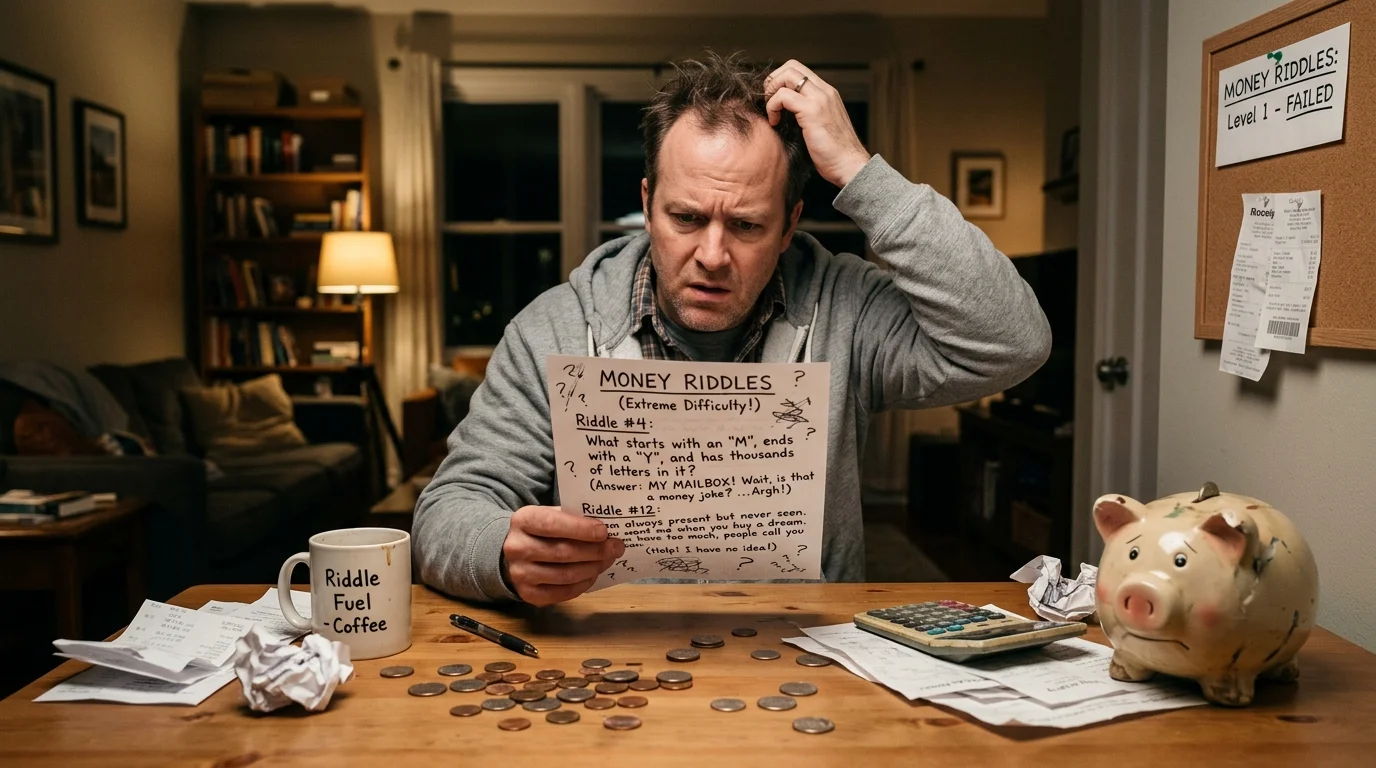
🪙 Easy Money Riddles for Kids
Start with these simple riddles about coins, notes, saving, and spending. They are ideal for younger children and early financial-literacy activities.
- I am small, round, and can jingle inside your pocket. What am I? 👉 A coin
- I am folded and carried in a wallet, but I am not a letter. What am I? 👉 A banknote
- I hold money safely until you decide to use it. What am I? 👉 A wallet
- I am where you put money when you want to keep it for later. What am I? 👉 A savings account
- I am something you receive after giving money for something you bought. What am I? 👉 Change
- I tell you how much something costs before you buy it. What am I? 👉 A price
- I am the money you give in exchange for something you want. What am I? 👉 Payment
- I am the place where people can buy things they need or want. What am I? 👉 A store
- I am money you keep instead of spending right away. What am I? 👉 Savings
- I can open doors to purchases but should be used wisely. What am I? 👉 Money
💵 Cash Riddles for Kids and Adults
Cash is one of the most familiar forms of money. These riddles explore notes, coins, pockets, wallets, and everyday transactions.
- I have a value printed on me and can be exchanged for goods. What am I? 👉 Cash
- I may be green, colorful, or decorated with important symbols depending on the country. What am I? 👉 A banknote
- I can be carried in your pocket but cannot walk anywhere myself. What am I? 👉 Cash
- I am made to be spent, saved, or exchanged. What am I? 👉 Money
- I can make your wallet heavier without adding any food. What am I? 👉 Coins
- I leave your hand when you pay for something. What am I? 👉 Money
- I can be counted one piece at a time or as a total amount. What am I? 👉 Cash
- I may be folded, carried, counted, and spent throughout the day. What am I? 👉 A banknote
- I can be kept in a wallet, purse, drawer, or safe. What am I? 👉 Cash
- I have value, but my value depends on the monetary system that accepts me. What am I? 👉 Money
🪙 Coin Riddles
Coins come in different sizes, shapes, and values. See how quickly you can solve these coin-themed clues.
- I am round, hard, and made to be carried in a pocket. What am I? 👉 A coin
- I can make a jingling sound when several of me travel together. What am I? 👉 Coins
- I am smaller than a banknote but can still represent money. What am I? 👉 A coin
- I may have a picture or symbol stamped onto my surface. What am I? 👉 A coin
- I can be tossed into a fountain, piggy bank, or vending machine. What am I? 👉 A coin
- I can be heads or tails but I am not an animal. What am I? 👉 A coin
- I can spin across a table without being a toy. What am I? 👉 A coin
- I am metal money that can make your pocket noisy. What am I? 👉 A coin
- I may have two different faces and an edge around me. What am I? 👉 A coin
- I am small enough to hide in your hand but useful when you need exact change. What am I? 👉 A coin
🐷 Saving Money Riddles
Saving is an important financial habit. These riddles make concepts like saving, goals, and piggy banks easier to remember.
- I grow when you put money away instead of spending it. What am I? 👉 Savings
- I have four legs but never walk, and children often feed me coins. What am I? 👉 A piggy bank
- I keep money for tomorrow instead of spending it today. What am I? 👉 Savings
- I am a target that helps you decide what you are saving toward. What am I? 👉 A savings goal
- I become fuller when you regularly put money inside me. What am I? 👉 A savings account
- I am money kept aside for something you may need later. What am I? 👉 Savings
- I can help you prepare for an unexpected expense. What am I? 👉 An emergency fund
- I am the habit of keeping some money instead of spending everything. What am I? 👉 Saving
- I may eventually help you afford something expensive without paying for it all at once. What am I? 👉 Savings
- I turn small amounts set aside regularly into a larger amount over time. What am I? 👉 Saving
🛍️ Spending and Shopping Riddles
Shopping involves prices, choices, payments, discounts, and change. These riddles turn everyday purchases into puzzles.
- I tell you what you must give before taking an item home. What am I? 👉 The price
- I reduce the amount you need to pay during a sale. What am I? 👉 A discount
- I am what remains when you pay more than the exact price. What am I? 👉 Change
- I am the money exchanged for something you buy. What am I? 👉 Payment
- I am the total cost of everything you place in your shopping basket. What am I? 👉 The bill
- I can make an expensive item temporarily cost less. What am I? 👉 A discount
- I am the paper or digital record showing what you bought and paid. What am I? 👉 A receipt
- I am the amount you pay after a discount is applied. What am I? 👉 The sale price
- I am the place where goods are displayed for customers to purchase. What am I? 👉 A store
- I can be a need, a want, or something chosen after comparing prices. What am I? 👉 A purchase
🏦 Bank Riddles
Banks play an important role in modern financial systems. These riddles introduce familiar banking terms in an easy way.
- I am a place where people can keep money and access financial services. What am I? 👉 A bank
- I record money deposited into and withdrawn from an account. What am I? 👉 A bank account
- I am money placed into an account. What am I? 👉 A deposit
- I am money taken out of an account. What am I? 👉 A withdrawal
- I am a machine that can let you withdraw cash without speaking to a teller. What am I? 👉 An ATM
- I can show how much money is available in an account. What am I? 👉 An account balance
- I am a number or code used to help protect access to an account or card. What am I? 👉 A PIN
- I am the process of putting money into a bank account. What am I? 👉 A deposit
- I am the process of taking money from a bank account. What am I? 👉 A withdrawal
- I can hold your money without being a physical wallet in your pocket. What am I? 👉 A bank account
💳 Credit and Debit Card Riddles
Cards make payments convenient, but they work in different ways. These riddles introduce common card-related ideas.
- I am a small plastic or digital payment tool carried in a wallet. What am I? 👉 A payment card
- I can take money directly from an account when you make a purchase. What am I? 👉 A debit card
- I can allow you to borrow money for purchases and repay it later. What am I? 👉 A credit card
- I contain numbers that help identify the card for payments. What am I? 👉 A payment card
- I may require a secret number before allowing a transaction. What am I? 👉 A debit card
- I let you pay without handing over physical notes or coins. What am I? 👉 A card
- I can be tapped against a compatible payment terminal. What am I? 👉 A contactless card
- I am money borrowed through a financial account and expected to be repaid. What am I? 👉 Credit
- I am the amount still owed on borrowed money. What am I? 👉 A balance
- I can make buying convenient but should be used responsibly. What am I? 👉 A payment card
🧾 Budget Riddles
A budget helps people plan how money will be used. These riddles introduce spending plans, income, expenses, and priorities.
- I am a plan for how you will use your money. What am I? 👉 A budget
- I tell you how much money comes in and where it may go. What am I? 👉 A budget
- I am money you receive from work or another source. What am I? 👉 Income
- I am money you spend on goods, services, or bills. What am I? 👉 An expense
- I help you decide which purchases matter most. What am I? 👉 A budget
- I become easier to manage when you write down what you earn and spend. What am I? 👉 Your finances
- I can show whether you are spending more than you planned. What am I? 👉 A budget
- I help turn a money goal into a spending and saving plan. What am I? 👉 A budget
- I am a regular cost such as rent, transportation, or food. What am I? 👉 An expense
- I am money left after expenses have been paid. What am I? 👉 A surplus
🧠 Hard Money Riddles for Older Kids and Adults
Ready for a tougher challenge? These riddles involve financial concepts that require a little more thought.
- I can make saved money grow over time, but my rate matters. What am I? 👉 Interest
- I am the original amount of money borrowed or invested. What am I? 👉 Principal
- I am the percentage used to describe the cost of borrowing or return on savings. What am I? 👉 An interest rate
- I am the increase in the general level of prices that can reduce purchasing power. What am I? 👉 Inflation
- I describe how much you can buy with a given amount of money. What am I? 👉 Purchasing power
- I am the chance that a financial outcome may not go as planned. What am I? 👉 Risk
- I am the practice of spreading money among different investments to reduce concentration risk. What am I? 👉 Diversification
- I am a financial plan designed to prepare for unexpected costs. What am I? 👉 An emergency fund
- I am the money left after subtracting expenses from income. What am I? 👉 Net cash flow
- I describe what you give up when choosing one option instead of another. What am I? 👉 Opportunity cost
📈 Investment Riddles
Investing introduces another side of money: putting resources to work with the hope of gaining value over time.
- I am money placed into an asset with the hope of earning a return. What am I? 👉 An investment
- I can represent ownership in a company. What am I? 👉 A share
- I am a basket containing different investments rather than just one. What am I? 👉 A portfolio
- I am money a company may distribute to shareholders. What am I? 👉 A dividend
- I am the gain or loss produced by an investment over a period. What am I? 👉 A return
- I can rise and fall in value and may involve financial risk. What am I? 👉 An investment
- I spread investments across different assets instead of putting everything in one place. What am I? 👉 Diversification
- I am a market where investors may buy and sell shares and other securities. What am I? 👉 A stock market
- I am the possibility that an investment will lose value. What am I? 👉 Investment risk
- I am the growth that happens when returns are added to an investment and then potentially earn returns themselves. What am I? 👉 Compound growth
🧮 Money Math Riddles
Money and mathematics go hand in hand. These puzzles are useful for practicing mental arithmetic and financial reasoning.
- I cost $7 and you give me $10. How much should come back to you? 👉 $3
- You save $5 each week for four weeks. How much do you save? 👉 $20
- A toy costs $12 and a book costs $8. What is the total? 👉 $20
- You have $25 and spend $9. How much remains? 👉 $16
- Three coins are worth $1 each. How much do they make together? 👉 $3
- You save $10 today and $15 next week. How much have you saved? 👉 $25
- An item costs $30 and has a $5 discount. What is the sale price? 👉 $25
- You have four $5 notes. How much money do you have? 👉 $20
- A $50 note is used to pay a $32 bill. How much change should you receive? 👉 $18
- You save $8 each month for three months. How much do you save? 👉 $24
😂 Funny Money Riddles
Money can be serious, but it can also inspire plenty of silly wordplay.
- Why did the coin go to school? 👉 It wanted to make more cents
- Why did the dollar bill feel confident? 👉 It knew it had value
- Why did the penny feel proud? 👉 It knew small amounts can add up
- Why did the wallet go to bed early? 👉 It was feeling worn out
- Why did the coin sit quietly? 👉 It did not want to make a cent-sation
- Why did the banknote tell a joke? 👉 It wanted to make some change
- Why did the piggy bank smile? 👉 It was feeling loaded
- Why did the shopper bring a calculator? 👉 The prices were adding up
- Why did the wallet complain? 👉 It was tired of being emptied
- Why did the coin avoid arguments? 👉 It preferred to keep its two cents
🧒 Money Riddles for Financial Literacy Lessons
Money riddles can be especially useful when children are learning basic financial concepts. A playful question can make a new word easier to remember.
- I am something you need rather than simply something you want. What am I? 👉 A need
- I am something you would like to have but may not need. What am I? 👉 A want
- I am money you earn from working. What am I? 👉 Income
- I am money you use to buy something. What am I? 👉 Spending
- I am money kept for a future purpose. What am I? 👉 Savings
- I am a plan for using your money wisely. What am I? 👉 A budget
- I am the money you receive after providing work or a service. What am I? 👉 Pay
- I am something you compare before deciding which product to buy. What am I? 👉 Price
- I am money borrowed that normally must be repaid. What am I? 👉 A loan
- I am a financial goal that gives you a reason to save. What am I? 👉 A savings goal
🎲 How to Use Money Riddles
Money riddles can turn financial education into a game.
For a classroom activity, divide students into teams and read each riddle aloud. Give one point for a correct answer. For math riddles, award an extra point when students explain how they reached the solution.
For younger children, use coin, wallet, piggy bank, saving, needs, and wants riddles. These concepts can help introduce basic money vocabulary in a fun way.
For family game night, hide the answers and let everyone compete. You can create a simple scoreboard and give bonus points for solving difficult riddles without hints.
For a financial-literacy lesson, connect each riddle to a short real-world example. After solving a budget riddle, for instance, ask students to imagine they have a certain amount of money and decide how much they would save and spend.
You can also ask learners to write their own money riddles. Give each person a financial term such as “budget,” “income,” “saving,” or “discount,” then challenge them to describe it without saying its name.
The best part is that the activity teaches more than vocabulary. It encourages careful thinking about how money works in everyday life.
🌟 Why Money Riddles Are Good for Learning
Money is something people encounter throughout their lives, yet financial vocabulary can sometimes feel complicated.
Riddles make those ideas easier to approach.
A child who solves a clue about a piggy bank is practicing the idea of saving. A student solving a discount puzzle is working with percentages and prices. Someone tackling an inflation riddle is connecting a financial term with purchasing power.
The playful format also encourages active recall. Instead of simply reading a definition, the solver must identify clues and retrieve the correct concept.
Money riddles can therefore work as warm-ups, review activities, conversation starters, or simple family games. They are not a replacement for proper financial education, but they can make important ideas more memorable.
Most importantly, they encourage a healthy habit: asking questions about money rather than being afraid of it.