
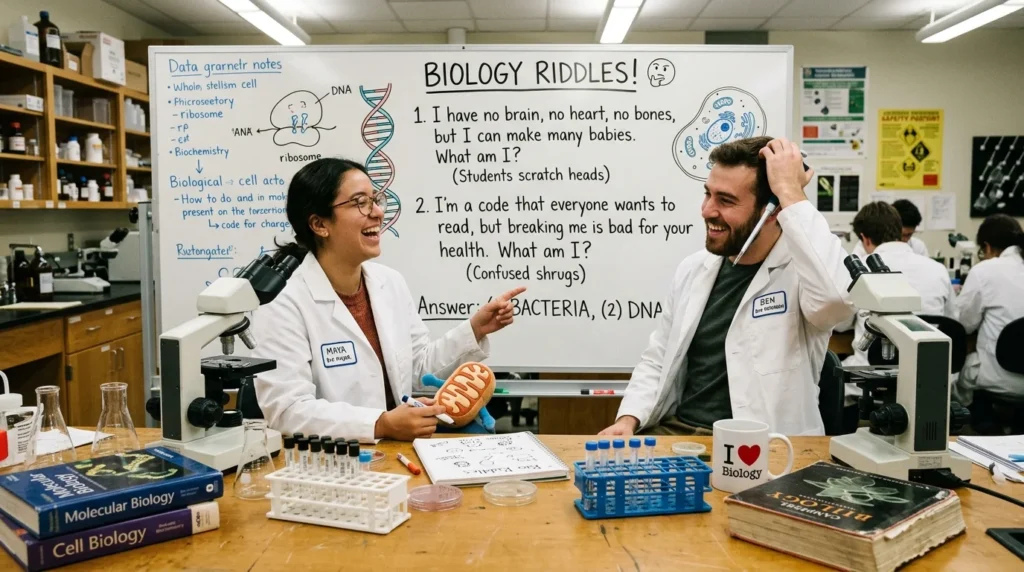
🧫 Easy Biology Riddles for Kids
These simple riddles introduce young learners to familiar biology words and ideas.
- I am the tiny building block found in every living thing. What am I? 👉 A cell
- I help plants make food using sunlight. What am I? 👉 A leaf
- I carry oxygen around your body. What am I? 👉 Blood
- I beat inside your chest without needing you to tell me. What am I? 👉 The heart
- I help you breathe by filling with air. What am I? 👉 The lungs
- I am green and help plants capture sunlight. What am I? 👉 Chlorophyll
- I am the organ that helps you think, remember, and learn. What am I? 👉 The brain
- I am the long structure that carries messages between your brain and body. What am I? 👉 A nerve
- I am a living creature that makes its own food from sunlight. What am I? 👉 A plant
- I am the part of a flower that can develop into a fruit after fertilization. What am I? 👉 The ovary
🧬 DNA and Genetics Riddles
DNA is like a biological instruction system. These riddles introduce genes, chromosomes, DNA, and inherited traits in a playful way.
- I look like a twisted ladder and carry instructions for life. What am I? 👉 DNA
- I am a section of DNA that contains instructions for a particular biological function. What am I? 👉 A gene
- I am a tightly organized structure made largely from DNA and proteins. What am I? 👉 A chromosome
- I carry inherited instructions from parents to their offspring. What am I? 👉 Genetic information
- I can influence traits such as eye color, hair characteristics, or blood type. What am I? 👉 A gene
- I have four famous bases often shortened to A, T, C, and G. What am I? 👉 DNA
- I am copied when a cell prepares to divide. What am I? 👉 DNA
- I am the molecule that carries genetic instructions in many living organisms. What am I? 👉 DNA
- I can be passed from parents to children without being a physical gift. What am I? 👉 Genes
- I am a trait that can be inherited from biological parents. What am I? 👉 An inherited trait
🔬 Cell Biology Riddles
Cells are tiny, but they perform enormous jobs. These puzzles focus on structures found inside or around cells.
- I am the control center of many cells and contain most of their DNA. What am I? 👉 The nucleus
- I surround a cell and help control what enters and leaves it. What am I? 👉 The cell membrane
- I am often called the cell’s powerhouse because I help release usable energy from food. What am I? 👉 A mitochondrion
- I help make proteins by reading genetic instructions carried by RNA. What am I? 👉 A ribosome
- I am a jelly-like material filling much of a cell’s interior. What am I? 👉 Cytoplasm
- I help package and process certain materials inside a cell. What am I? 👉 The Golgi apparatus
- I am a network inside cells involved in making and transporting molecules. What am I? 👉 The endoplasmic reticulum
- I contain digestive enzymes that can break down cellular materials. What am I? 👉 A lysosome
- I am found in plant cells and capture light energy for photosynthesis. What am I? 👉 A chloroplast
- I give plant cells extra support and shape outside the cell membrane. What am I? 👉 The cell wall
🌱 Plant Biology Riddles
Plants may seem quiet, but they are constantly carrying out complex biological processes. Try these plant-themed puzzles.
- I use sunlight, water, and carbon dioxide to help make food for a plant. What am I? 👉 Photosynthesis
- I drink water from the soil and send it upward through the plant. What am I? 👉 Roots
- I carry water upward from the roots through the plant. What am I? 👉 Xylem
- I transport sugars made by the plant to different parts of the plant. What am I? 👉 Phloem
- I hold a plant in the soil and absorb water and minerals. What am I? 👉 Roots
- I am the green pigment that captures light energy. What am I? 👉 Chlorophyll
- I am the part of a plant that often contains petals and helps with reproduction. What am I? 👉 A flower
- I protect a developing plant inside many flowering plants. What am I? 👉 A seed
- I grow downward into the soil while a young shoot grows upward. What am I? 👉 A root
- I open toward light and help a plant capture energy from the Sun. What am I? 👉 A leaf
🫀 Human Body Biology Riddles
The human body is a remarkable biological system. These riddles test what you know about organs and body functions.
- I pump blood throughout your body day and night. What am I? 👉 The heart
- I take oxygen from the air and release carbon dioxide. What am I? 👉 The lungs
- I protect your brain with a hard bony case. What am I? 👉 The skull
- I help break food into smaller substances your body can use. What am I? 👉 The digestive system
- I absorb many nutrients from digested food. What am I? 👉 The small intestine
- I store bile and release it to help with digestion. What am I? 👉 The gallbladder
- I filter waste from your blood and help make urine. What am I? 👉 The kidneys
- I am the largest organ of the human body and protect what lies beneath me. What am I? 👉 The skin
- I connect muscles to bones and help transfer pulling forces. What am I? 👉 A tendon
- I connect bones to other bones and help stabilize joints. What am I? 👉 A ligament
- I send electrical signals that help coordinate the body. What am I? 👉 The nervous system
- I carry oxygen-rich blood from the lungs to the rest of the body. What am I? 👉 Arteries
🧠 Brain and Nervous System Riddles
Your nervous system allows the body to sense, respond, move, and communicate. These riddles explore some of its major parts.
- I sit inside your skull and help you think, learn, and remember. What am I? 👉 The brain
- I carry messages between the brain and other parts of the body. What am I? 👉 Nerves
- I am the long pathway connecting the brain with many nerves throughout the body. What am I? 👉 The spinal cord
- I am a specialized cell that sends electrical and chemical signals. What am I? 👉 A neuron
- I help you react quickly when something hot touches your skin. What am I? 👉 A reflex
- I help control balance, movement, and coordination. What am I? 👉 The cerebellum
- I help process information from your senses and guide many body functions. What am I? 👉 The brain
- I allow signals to pass between nerve cells across tiny gaps. What am I? 👉 A synapse
🐾 Animal Biology Riddles
Animals come in countless shapes and sizes. Their bodies have evolved remarkable ways to survive in different environments.
- I am an animal that begins life as a tadpole before developing into an adult form. What am I? 👉 A frog
- I have feathers, wings, and a beak, and many of my relatives can fly. What am I? 👉 A bird
- I breathe through gills and live in water. What am I? 👉 A fish
- I am a mammal that feeds my young with milk and can live in the ocean. What am I? 👉 A whale
- I have eight arms and can change color to blend with my surroundings. What am I? 👉 An octopus
- I carry my home on my back and move slowly across the ground. What am I? 👉 A tortoise
- I transform from a caterpillar into a winged adult. What am I? 👉 A butterfly
- I use echolocation to help find my way in darkness. What am I? 👉 A bat
- I am a mammal known for laying eggs rather than giving birth to live young. What am I? 👉 A platypus
- I have six legs and three main body sections. What am I? 👉 An insect
🌎 Ecology and Ecosystem Riddles
Ecology explores how living things interact with one another and with their surroundings. These riddles introduce food chains, habitats, populations, and ecosystems.
- I am the place where an organism lives and finds what it needs to survive. What am I? 👉 A habitat
- I contain living organisms and their physical surroundings working together. What am I? 👉 An ecosystem
- I make my own food and can become the first energy source in many food chains. What am I? 👉 A producer
- I eat plants or other organisms to obtain energy. What am I? 👉 A consumer
- I break down dead material and return nutrients to the environment. What am I? 👉 A decomposer
- I show how energy moves from one organism to another through feeding. What am I? 👉 A food chain
- I am a group of organisms of the same species living in one area. What am I? 👉 A population
- I am all the different populations living and interacting in one area. What am I? 👉 A community
- I am the natural home of a particular organism. What am I? 👉 A habitat
- I am the movement of water between Earth, the atmosphere, and living things. What am I? 👉 The water cycle
🦠 Microbiology Riddles
The microscopic world is packed with organisms and structures too small to see with the naked eye.
- I am a microscopic organism with no nucleus and can live in many environments. What am I? 👉 A bacterium
- I can infect cells but need a host cell to reproduce. What am I? 👉 A virus
- I am a microscopic fungus commonly used to make bread rise. What am I? 👉 Yeast
- I am a single-celled organism that can be found in many environments. What am I? 👉 A microorganism
- I am one of the two major groups of organisms whose cells lack a nucleus. What am I? 👉 Bacteria
- I can live on and inside other organisms, sometimes helping them and sometimes causing disease. What am I? 👉 A microorganism
- I am much smaller than most cells and carry genetic material inside a protein coat. What am I? 👉 A virus
- I help break down dead material in many ecosystems. What am I? 👉 Microorganisms
- I can multiply rapidly when conditions are favorable and am used to make some foods. What am I? 👉 Bacteria
- I am the microscopic fungus that helps turn dough into a fluffy loaf. What am I? 👉 Yeast
🧪 Biology Riddles About Enzymes and Metabolism
Living organisms need energy and chemical reactions to survive. Enzymes help many biological reactions happen efficiently.
- I am a biological catalyst that helps chemical reactions happen faster. What am I? 👉 An enzyme
- I fit into an enzyme’s active site and take part in a reaction. What am I? 👉 A substrate
- I am the specific region of an enzyme where a substrate binds. What am I? 👉 The active site
- I help cells obtain usable energy from nutrients. What am I? 👉 Cellular respiration
- I am a molecule that stores and transfers usable energy in cells. What am I? 👉 ATP
- I am the process plants use to capture light energy and build sugars. What am I? 👉 Photosynthesis
- I am a gas used by many organisms during aerobic cellular respiration. What am I? 👉 Oxygen
- I am a waste gas produced during cellular respiration and used by plants in photosynthesis. What am I? 👉 Carbon dioxide
🧬 Genetics and Evolution Riddles
Biology changes across generations. Genes, variation, reproduction, and natural selection all contribute to the diversity of life.
- I describe changes in inherited characteristics within populations across generations. What am I? 👉 Evolution
- I am a difference in DNA sequence that can contribute to genetic variation. What am I? 👉 A mutation
- I help populations become better suited to their environments over generations through natural selection. What am I? 👉 Adaptation
- I am the process in which organisms with helpful inherited traits tend to leave more offspring. What am I? 👉 Natural selection
- I am genetic material packaged into structures called chromosomes. What am I? 👉 DNA
- I describe the genetic makeup of an organism. What am I? 👉 Genotype
- I describe observable characteristics influenced by genes and environment. What am I? 👉 Phenotype
- I am the passing of genetic information from parents to offspring. What am I? 👉 Heredity
- I am a version of a gene. What am I? 👉 An allele
- I increase biological variety within a population. What am I? 👉 Genetic variation
🧠 Hard Biology Riddles for Older Students
These puzzles require a little more biological knowledge and are great for high school students, science clubs, and curious adults.
- I copy myself before a cell divides so each new cell can receive genetic information. What am I? 👉 DNA
- I separate duplicated chromosomes into new cells during cell division. What am I? 👉 Mitosis
- I create reproductive cells with half the usual chromosome number. What am I? 👉 Meiosis
- I join with another reproductive cell during fertilization to begin a new organism. What am I? 👉 A gamete
- I am the process in which a cell copies DNA into RNA. What am I? 👉 Transcription
- I am the process in which ribosomes use mRNA instructions to build a protein. What am I? 👉 Translation
- I am a three-base sequence in mRNA that helps specify an amino acid or a stop signal. What am I? 👉 A codon
- I am the movement of water across a selectively permeable membrane toward the side with greater solute concentration. What am I? 👉 Osmosis
- I am the movement of particles from an area of higher concentration toward an area of lower concentration. What am I? 👉 Diffusion
- I maintain relatively stable internal conditions even when the outside environment changes. What am I? 👉 Homeostasis
🎓 Biology Riddles for Students and Classrooms
Teachers can use these riddles as warm-ups, review questions, quiz games, or science discussion starters.
- I am the basic structural and functional unit of life. What am I? 👉 A cell
- I contain the instructions that help determine inherited traits. What am I? 👉 DNA
- I am the process by which green plants use light energy to make sugars. What am I? 👉 Photosynthesis
- I am the process cells use to release usable energy from nutrients. What am I? 👉 Cellular respiration
- I am the organ that pumps blood through the circulatory system. What am I? 👉 The heart
- I am the organ system responsible for taking in oxygen and removing carbon dioxide. What am I? 👉 The respiratory system
- I am the system that breaks food into smaller molecules that can be absorbed. What am I? 👉 The digestive system
- I am the process that produces two genetically similar daughter cells. What am I? 👉 Mitosis
- I am the process that produces haploid reproductive cells. What am I? 👉 Meiosis
- I am the study of living organisms and how they function. What am I? 👉 Biology
🎲 How to Use Biology Riddles for Learning
Biology riddles can turn a normal study session into a quick science game.
For younger learners, read the clue aloud and allow them to visualize the answer before revealing it. Simple questions about animals, plants, and body parts can build confidence while introducing scientific vocabulary.
For older students, hide the answers and turn the activity into a team competition. Students can earn extra points by explaining which clue helped them solve each riddle.
Teachers can also use riddles as lesson starters. A question about DNA can introduce genetics. A riddle about chloroplasts can lead into photosynthesis. A question about decomposers can open a discussion about nutrient cycles and ecosystems.
Another useful activity is to have students write their own biology riddles. Give each student a biological term and ask them to create three clues without saying the word itself.
This encourages students to understand a concept well enough to describe it in their own words—a valuable skill for science learning.
🌟 Why Biology Riddles Are Good for Science Learning
Science is often filled with unfamiliar vocabulary. Words such as mitochondria, chromosome, photosynthesis, homeostasis, and ecosystem can seem difficult when first encountered.
Riddles give those terms a memorable context.
Instead of simply memorizing that mitochondria are involved in cellular energy production, a student can remember the playful clue about a tiny cellular “powerhouse.” Instead of treating DNA as a list of letters, a learner can picture it as a twisted ladder carrying biological instructions.
Riddles also encourage students to identify clues, connect ideas, recall facts, and think creatively. They can make review sessions less stressful and give learners another way to interact with scientific information.
Most importantly, biology riddles remind us that science is not just about memorizing facts. It is about asking questions, noticing patterns, making connections, and being curious about how life works.