
📖 Easy Islamic Riddles for Kids
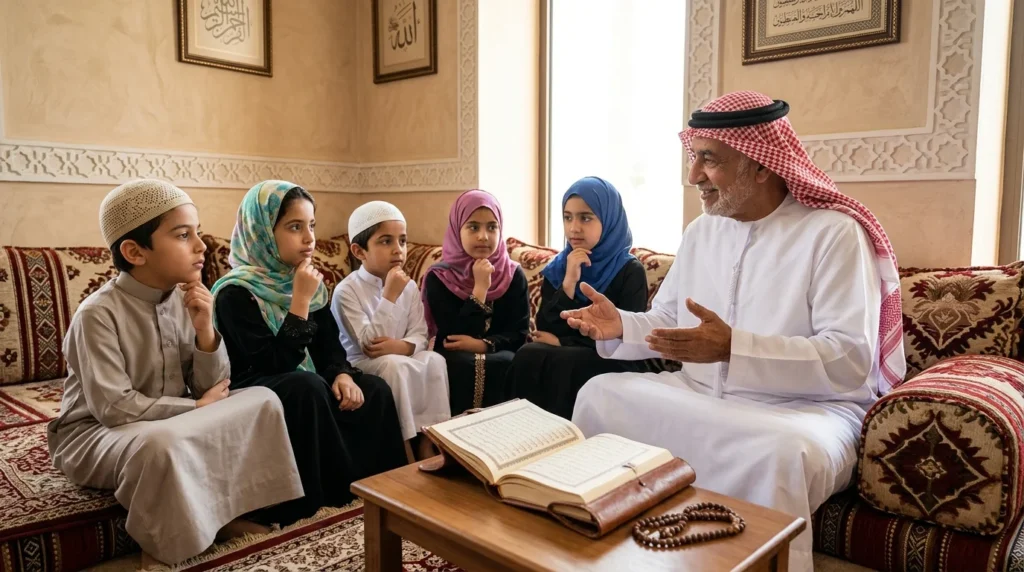
These simple riddles introduce young learners to familiar Islamic words and practices. They are useful for parents, Sunday schools, madrassahs, Islamic studies classes, and family quiz time.
- I am the holy book of Islam, recited and studied by Muslims around the world. What am I? 👉 The Quran
- I am the special place where Muslims gather to pray. What am I? 👉 A mosque
- I happen five times each day and includes standing, bowing, and prostration. What am I? 👉 Salah
- I am the month when Muslims fast from dawn until sunset. What am I? 👉 Ramadan
- I am the meal eaten before the daily fast begins. What am I? 👉 Suhoor
- I am the meal that breaks the fast at sunset. What am I? 👉 Iftar
- I am the direction Muslims face during salah. What am I? 👉 The Qiblah
- I am the sacred building toward which Muslims face during prayer. What am I? 👉 The Ka’bah
- I am the greeting Muslims often share with one another. What am I? 👉 Assalamu alaikum
- I am the act of giving a portion of qualifying wealth to those entitled to receive it. What am I? 👉 Zakat
These basic riddles can help children connect Islamic vocabulary with everyday religious practice. Parents can make the activity more interactive by asking children to explain what they know about each answer.
🕌 Islamic Riddles About Salah and Prayer
Salah is one of the central acts of worship in Islam. These riddles explore words and actions connected with prayer.
- I am performed five times each day by Muslims as an act of worship. What am I? 👉 Salah
- I am the direction Muslims face while performing salah. What am I? 👉 Qiblah
- I am the washing Muslims perform before salah when purification is needed. What am I? 👉 Wudu
- I am the standing position during salah. What am I? 👉 Qiyam
- I am the bowing position during prayer. What am I? 👉 Ruku
- I am the prostration in which a worshipper places the forehead on the ground. What am I? 👉 Sujood
- I am the person who leads a congregational prayer. Who am I? 👉 Imam
- I am the call announcing that it is time for a prayer. What am I? 👉 Adhan
- I am the person who gives the call to prayer. Who am I? 👉 Mu’adhdhin
- I am the place where Muslims may stand together in rows for congregational prayer. What am I? 👉 The mosque
Prayer involves more than physical movements. It is an act of worship that gives Muslims a regular opportunity to remember Allah and turn their attention toward Him.
For children, these riddles can also help introduce vocabulary before a lesson about salah. Teachers can ask students to match each answer with its meaning or explain where the word appears in the prayer routine.
🌙 Islamic Riddles About Ramadan
Ramadan is a special month for Muslims around the world. It is associated with fasting, worship, generosity, reflection, and community.
- I arrive once each year and am known as the month of fasting. What am I? 👉 Ramadan
- I am the meal Muslims eat before dawn during a fasting day. What am I? 👉 Suhoor
- I am the meal eaten when the sun has set and the daily fast ends. What am I? 👉 Iftar
- I am the act of avoiding food and drink from dawn until sunset during the Ramadan fast. What am I? 👉 Fasting
- I am the night described in the Quran as better than a thousand months. What am I? 👉 Laylat al-Qadr
- I am the special night prayer commonly performed in congregation during Ramadan. What am I? 👉 Taraweeh
- I am the charity commonly given at the end of Ramadan before Eid prayer. What am I? 👉 Zakat al-Fitr
- I am the celebration that comes after Ramadan. What am I? 👉 Eid al-Fitr
- I am the evening meal that brings a fast to an end. What am I? 👉 Iftar
- I am the month in which Muslims seek extra opportunities for worship and good deeds. What am I? 👉 Ramadan
Ramadan riddles can be especially useful during family activities. Children can solve a few before iftar, while teachers can use them as warm-up questions during Islamic studies lessons.
📕 Islamic Riddles About the Quran
The Quran holds a central place in Islam. These riddles focus on basic Quranic knowledge and vocabulary.
- I am the revelation Muslims believe was sent by Allah to Prophet Muhammad. What am I? 👉 The Quran
- I am the chapter of the Quran that Muslims recite in every unit of salah. What am I? 👉 Surah Al-Fatihah
- I am the Arabic term commonly used for a verse of the Quran. What am I? 👉 Ayah
- I am the Arabic word commonly used for a chapter of the Quran. What am I? 👉 Surah
- I am the language in which the Quran was revealed. What language am I? 👉 Arabic
- I am the angel who, according to Islamic tradition, brought revelation to Prophet Muhammad. Who am I? 👉 Jibril
- I am the first word of the first revealed passage commonly translated as “Read” or “Recite.” What word am I? 👉 Iqra
- I am the practice of reading or reciting the Quran. What am I? 👉 Tilawah
- I am the memorization of the Quran. What am I? 👉 Hifz
- I am a person who has memorized the Quran. What am I called? 👉 Hafiz
These riddles can encourage children to become curious about Quranic vocabulary. After solving them, a teacher or parent can add a short explanation so the puzzle becomes the beginning of a learning conversation.
👳 Islamic Riddles About the Prophets
Prophets hold an important place in Islamic belief. The Quran mentions many prophets and messengers, and their stories contain lessons about patience, faith, courage, obedience, and trust in Allah.
- I built the Ark by Allah’s command before the great flood. Who am I? 👉 Prophet Nuh
- I was placed in the fire, but Allah protected me. Who am I? 👉 Prophet Ibrahim
- I was known for my remarkable patience during severe trials. Who am I? 👉 Prophet Ayyub
- I was given the ability to interpret dreams by Allah’s permission. Who am I? 👉 Prophet Yusuf
- I spoke to Allah and was given the mission to confront Pharaoh. Who am I? 👉 Prophet Musa
- I was born miraculously to Maryam and was given signs by Allah. Who am I? 👉 Prophet Isa
- I am the final prophet and messenger in Islam. Who am I? 👉 Prophet Muhammad
- I was the father of Prophet Ismail and Prophet Ishaq. Who am I? 👉 Prophet Ibrahim
- I was the mother of Prophet Isa and am honored in Islamic tradition. Who am I? 👉 Maryam
- I was a prophet associated with the great kingdom and wisdom given by Allah. Who am I? 👉 Prophet Sulayman
When using these riddles with children, it is helpful to focus on the lessons found in the stories rather than treating the prophets’ lives as ordinary trivia. A riddle can be the first step toward discussing patience, honesty, trust, and obedience.
🕋 Islamic Riddles About Hajj and the Ka’bah
Hajj is a major act of worship and one of the Five Pillars of Islam for those who are able to perform it. These riddles introduce some of its familiar places and practices.
- I am the sacred structure in Makkah toward which Muslims face during prayer. What am I? 👉 The Ka’bah
- I am the pilgrimage to Makkah that Muslims perform during a specific time of the Islamic year. What am I? 👉 Hajj
- I am the sacred city where the Ka’bah is located. What city am I? 👉 Makkah
- I am the journey between two small hills performed during Hajj and Umrah. What am I? 👉 Sa’i
- I am the hill where pilgrims gather during Hajj on the Day of Arafah. What am I? 👉 Arafat
- I am the state of sacred consecration entered before performing certain Hajj or Umrah rites. What am I? 👉 Ihram
- I am the act of circling the Ka’bah. What am I? 👉 Tawaf
- I am the sacred well near the Ka’bah associated with Hajar and Prophet Ismail. What am I? 👉 Zamzam
- I am the pilgrimage that can be performed at other times of the year and is not one of the Five Pillars. What am I? 👉 Umrah
- I am the ancient house at the heart of Masjid al-Haram. What am I? 👉 The Ka’bah
These puzzles can help children become familiar with the vocabulary of Hajj before learning about its rituals in greater detail.
❤️ Islamic Riddles About Good Character and Values
Islamic learning is not only about knowing names and terms. Good character, kindness, honesty, patience, gratitude, and generosity are also important themes in Islamic teachings.
- I mean telling the truth even when it is difficult. What quality am I? 👉 Honesty
- I mean giving help or goodness to someone who needs it. What quality am I? 👉 Kindness
- I mean remaining calm and steady during difficulty. What quality am I? 👉 Patience
- I mean being thankful for blessings. What quality am I? 👉 Gratitude
- I mean giving to others without demanding something in return. What quality am I? 👉 Generosity
- I mean treating parents with care, respect, and kindness. What quality am I? 👉 Kindness to parents
- I mean keeping something safe when another person trusts you with it. What quality am I? 👉 Trustworthiness
- I mean forgiving someone instead of holding tightly to anger. What quality am I? 👉 Forgiveness
- I mean treating people fairly and giving them their rights. What quality am I? 👉 Justice
- I mean remembering Allah and keeping Him in one’s thoughts. What am I? 👉 Dhikr
These riddles are excellent discussion starters. After each answer, ask children for one real-life example. For instance, after “honesty,” ask them how they could show honesty at school or at home.
🧕 Islamic Riddles About Important Muslim Words
Learning key Islamic vocabulary can make religious lessons easier to understand. These riddles offer a playful way to review common terms.
- I am the Arabic word for peace and a common Muslim greeting. What am I? 👉 Salam
- I mean placing trust in Allah while also doing what is required of you. What concept am I? 👉 Tawakkul
- I mean being conscious of Allah and living with awareness of Him. What concept am I? 👉 Taqwa
- I mean a sincere intention behind an action. What am I? 👉 Niyyah
- I mean remembering Allah through words and the heart. What am I? 👉 Dhikr
- I mean charity or obligatory almsgiving from qualifying wealth. What am I? 👉 Zakat
- I mean a voluntary act of charity or kindness. What am I? 👉 Sadaqah
- I mean placing one’s forehead on the ground during prayer. What am I? 👉 Sujood
- I mean purification or cleanliness required for certain acts of worship. What am I? 👉 Taharah
- I am the Arabic word commonly used for a permissible action. What am I? 👉 Halal
Islamic vocabulary can sometimes feel difficult when children first encounter it. Riddles turn unfamiliar words into small mysteries, making them easier to remember through association.
🎉 Fun Islamic Riddles for Family and School Activities
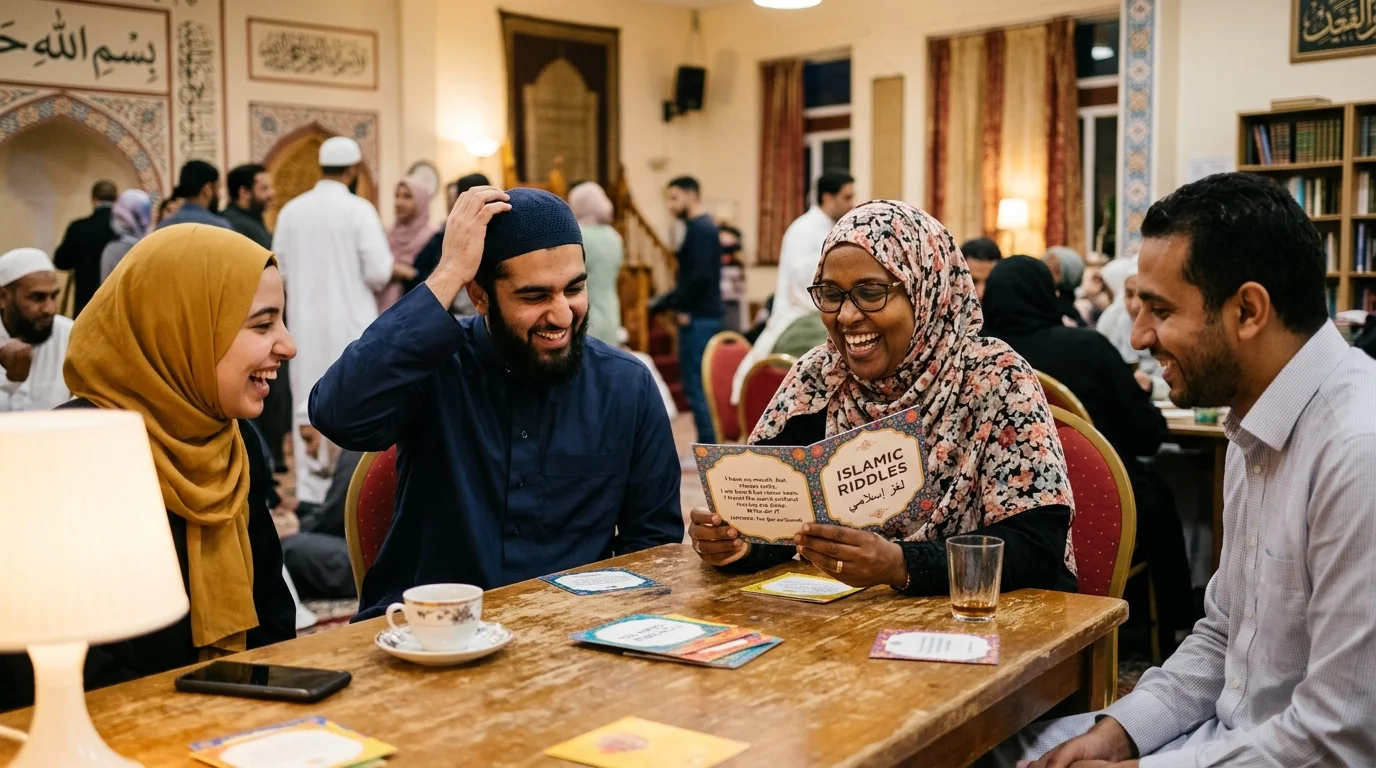
These light, respectful riddles are suitable for family quiz nights, Islamic school events, youth activities, and group games.
- I have no voice of my own, but when recited, my words can fill a quiet room. What am I? 👉 The Quran
- I have no wings, but I take worshippers from one prayer to another throughout their day. What am I? 👉 Salah
- I arrive with a call and gather people toward prayer. What am I? 👉 Adhan
- I may be filled with dates, water, and smiles when the sun goes down during Ramadan. What am I? 👉 An iftar table
- I point in one direction but never move from my place. What am I? 👉 The Qiblah
- I can be whispered with the tongue and remembered by the heart. What am I? 👉 Dhikr
- I can be given with money, food, time, or a helpful action. What am I? 👉 Sadaqah
- I can begin with a sincere heart before an act of worship. What am I? 👉 Niyyah
- I may be heard across a neighborhood when prayer time arrives. What am I? 👉 The Adhan
- I can be learned by listening, reading, repeating, and practicing. What am I? 👉 Islamic knowledge
The best family activities allow everyone to participate. Younger children can answer the easy clues, while older children can explain the meanings behind more difficult terms.
🌟 Challenging Islamic Riddles for Teens and Adults
These puzzles are a little more demanding. They work well for Islamic trivia sessions, youth groups, classroom competitions, and family quiz nights.
- I am one of the Five Pillars and involve giving from qualifying wealth to eligible recipients. What am I? 👉 Zakat
- I am one of the Five Pillars and require eligible Muslims to fast during my month. What am I? 👉 Sawm
- I am one of the Five Pillars and involve pilgrimage to Makkah for those able to perform it. What am I? 👉 Hajj
- I am one of the Five Pillars and involve worshipping Allah through the testimony of faith. What am I? 👉 Shahadah
- I am one of the Five Pillars performed at appointed times throughout the day. What am I? 👉 Salah
- I am the Islamic calendar’s month associated with fasting and the revelation of the Quran. What month am I? 👉 Ramadan
- I am the direction toward the Ka’bah that Muslims face in salah. What am I? 👉 Qiblah
- I am the journey between Safa and Marwah that is part of Hajj and Umrah. What am I? 👉 Sa’i
- I am the Arabic term for a person who strives to memorize the Quran. What am I? 👉 A student of hifz
- I am the night in Ramadan associated with great virtue and described as better than a thousand months. What am I? 👉 Laylat al-Qadr
For challenging quizzes, encourage players to explain the clue rather than simply giving the answer. This makes the activity more educational and helps prevent simple guessing.